
Single ‘digital nation-state’ is not a far-fetched notion, Melania Trump tells UN Security Council

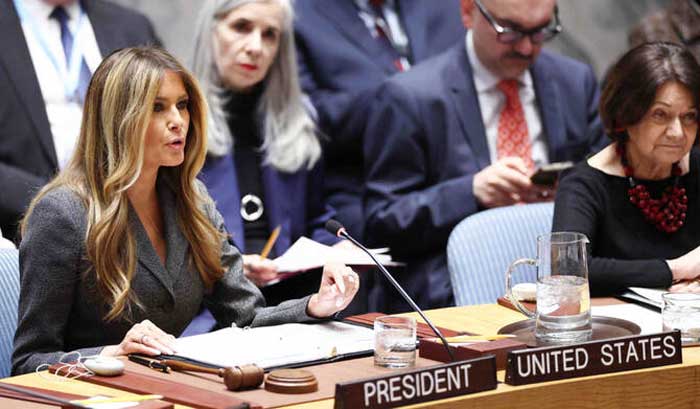
The concept of a single digital nation-state may not be as distant as it sounds, US First Lady Melania Trump told the United Nations Security Council on Monday, arguing that artificial intelligence and global connectivity are reshaping education, reducing conflict and empowering children worldwide.
As the United States holds the council’s rotating presidency for March, Trump presided over its first meeting of the month and said rapid technological advances are erasing borders and creating what she described as a shared intellectual future.
“Perhaps this idea isn’t so far-fetched,” she said, citing the growth of digital currencies, blockchain-based payment systems and AI-driven databases that she argued are already transforming media and global financial markets.
Trump thanked fellow council members — including the United Kingdom, France, Russia, China, Greece, the Democratic Republic of the Congo, Denmark, Panama, Liberia, Somalia, Colombia, Pakistan, Bahrain and Latvia — for their work in maintaining international security.
The responsibility to prevent conflict “must be applied evenly and should never be carried out lightly,” she said, emphasizing education as the cornerstone of peace and stability.
“A nation that makes learning sacred protects its books, its language, its science and its mathematics. It protects its future,” Trump said. Societies rooted in knowledge, she argued, foster innovation, tolerance and ethical reasoning, while those shaped by ignorance risk instability and conflict.
Education is a fundamental human right, she added, yet millions of children and young adults remain unable to attend high school or university. The loss of that untapped potential — from missed medical breakthroughs to advances in food security and technology — affects not just individual nations but humanity as a whole.
Trump called for expanding global access to technology to narrow the digital divide, noting that roughly 6 billion people — about 70 percent of the world’s population — now use mobile devices and the internet.
“If our nations band together, we can close the technological divide,” she said, envisioning a world where a farmer on a remote Greek island, a student in Somalia and a resident of New York City can equally access centuries of accumulated knowledge.
Artificial intelligence, she added, is democratizing information once confined to university libraries and redefining participation in the global “economy of ideas.”
“Conflict arises from ignorance. Knowledge creates understanding, replacing fear with peace and unity,” Trump said.
She urged council members to safeguard education and expand access to higher learning, calling on them to “build a future generation of leaders who embrace peace through education.”
“The path to peace,” she concluded, “depends on us taking responsibility to empower our children through education and technology.”
Comments are closed.