
Senate Engulfed in Marathon Debate as GOP Pushes Trump’s Tax and Spending Bill Amid Democratic Resistance

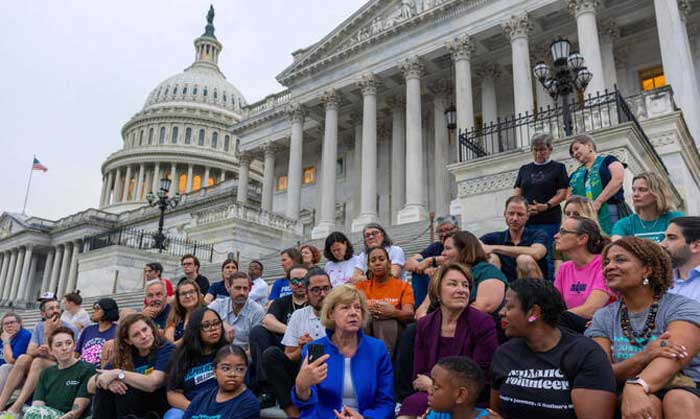
The U.S. Senate launched into an all-night session Sunday as Republicans raced to advance President Donald Trump’s sweeping tax cut and spending plan against fierce Democratic resistance — and even internal GOP doubts over deep budget reductions.
With Trump demanding a vote before his self-imposed July 4 deadline, GOP leaders barely cleared a key procedural hurdle on Saturday, salvaging momentum after intense lobbying from Trump himself and a visit by Vice President J.D. Vance. But the path forward remains volatile, with several Republican senators expressing concern over steep cuts to Medicaid and other safety-net programs.
One high-profile casualty emerged Sunday when Sen. Thom Tillis (R-N.C.) announced he would not seek reelection in 2026. His decision followed sustained criticism from Trump for opposing the bill’s health care cuts. “We could take the time to get this right,” Tillis said in a floor speech. “But until then, I remain opposed.”
The nearly $4 trillion package would permanently extend Trump’s 2017 tax cuts and introduce new measures, such as eliminating taxes on tips. It also slashes more than $1.2 trillion over the decade, largely by tightening eligibility for Medicaid and food stamps, and rolls back green energy tax credits Democrats say are vital to the country’s climate transition. A $350 billion boost to border and national security — including expanded deportation funding — is included as well.
Democrats, unable to block the bill outright due to the budget reconciliation process, are using every procedural tool to stall progress. They forced a full reading of the 940-page bill, which lasted about 16 hours, and have launched into lengthy speeches and amendment proposals.
“This is reckless and irresponsible,” said Sen. Gary Peters (D-Mich.). “A gift to the billionaire class,” echoed Sen. Bernie Sanders (I-Vt.), who criticized the bill’s massive tax breaks alongside cuts that would affect millions.
A fresh Congressional Budget Office (CBO) analysis found the bill would add nearly $3.3 trillion to the national deficit by 2034, while leaving 11.8 million more Americans uninsured. Despite this, some conservative Republicans are demanding even deeper spending cuts — prompting a rare warning from Trump himself. “Don’t go too crazy!” the president posted on social media. “REMEMBER, you still have to get reelected.”
Democrats also took aim at the Republicans’ accounting tactics, which treat Trump’s expiring 2017 tax cuts as “current policy” and exclude their extension from deficit projections. “That kind of magic math won’t fly with families balancing their own books,” said Sen. Patty Murray (D-Wash.), the longest-serving Democrat on the Budget Committee.
Though Republicans hold a slim 53-47 majority in the Senate, GOP leaders can afford no more than three defections. On Saturday, eyes turned to key moderates like Sen. Lisa Murkowski (R-Alaska), who ultimately voted yes after securing Alaska-specific provisions. However, some of those may be challenged by the Senate parliamentarian.
Majority Whip John Thune (R-S.D.) was seen in closed-door talks with skeptical GOP senators including Rick Scott (Fla.), Mike Lee (Utah), and Cynthia Lummis (Wyo.), trying to shore up support. Scott later said, “We all want to get to yes.”
House Speaker Mike Johnson has told members to remain on call in case the Senate passes the bill and sends it back to the House for final approval.
As the Senate braces for a long night of amendment votes and debate, the outcome remains uncertain — but the political stakes are clear. With health care access, climate funding, and economic policy hanging in the balance, both parties are digging in for one of the most consequential showdowns of Trump’s second term.
Comments are closed.