
Rubio reiterates ‘no Russian oil’ stance as Jaishankar stresses strategic autonomy; questions linger over Trump’s tariff order

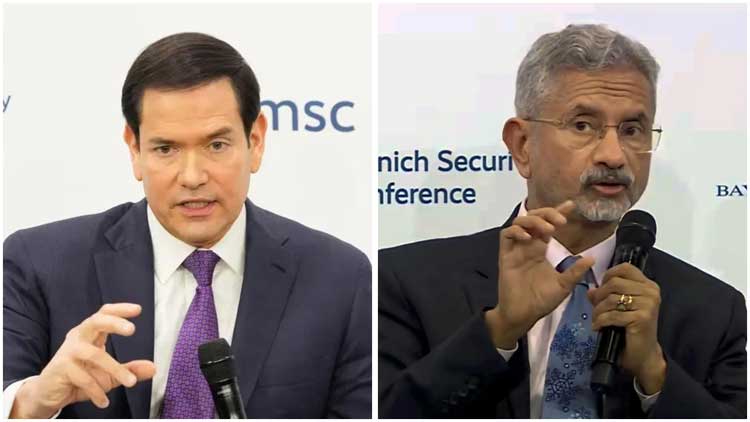
Fresh comments from Marco Rubio at the Munich Security Conference have reignited political debate in India over Washington’s claim that New Delhi has committed to curbing Russian oil purchases under the evolving India–US trade framework.
Speaking in Munich, the US Secretary of State said that in discussions with India, the United States had obtained a commitment from New Delhi to stop buying “additional Russian oil.” The phrasing immediately drew attention, particularly the qualifier “additional,” which some analysts interpret as leaving room for existing contracts or shipments already in the pipeline.
The remarks come amid continuing assertions from the administration of Donald Trump that India agreed to scale back Russian energy imports as part of a broader tariff and trade understanding. While the US side has presented this as a settled element of the framework, India has neither formally confirmed nor publicly endorsed such a commitment.
Jaishankar avoids direct endorsement
India’s External Affairs Minister S. Jaishankar, who also participated in the Munich conference, stopped short of validating Rubio’s statement. Instead, he restated India’s long-held position that energy sourcing decisions are governed by market considerations rather than geopolitical alignments.
“Where the energy issues are concerned, this is today a complex market,” Jaishankar said during a public discussion. “Oil companies in India — as in Europe and elsewhere — look at availability, cost and risks, and take decisions that they feel are in their best interests.”
He further emphasised that India remains “very much wedded to strategic autonomy,” underlining that independent decision-making continues to shape the country’s foreign and economic policies.
Trade deal backdrop
The controversy unfolds against the backdrop of the India–US trade framework announced earlier this month by Donald Trump and subsequently acknowledged by Prime Minister Narendra Modi. As part of the arrangement, Washington removed a 25% punitive tariff previously linked to India’s purchase of Russian crude.
The executive order authorising the tariff rollback indicated that India had agreed to refrain from Russian oil imports — language that has fueled intense debate in New Delhi. However, Indian officials have so far refrained from explicitly addressing that specific claim.
Under the framework, the remaining reciprocal tariff component is expected to decline to 18% once a formal Bilateral Trade Agreement (BTA) is concluded.
Monitoring clause raises stakes
Notably, the US executive order also includes a monitoring mechanism directing American authorities to track India’s oil import patterns. Should India be deemed to have “resumed directly or indirectly” importing Russian oil, the punitive tariffs could be reinstated.
Strategic affairs expert Brahma Chellaney has argued that this clause effectively creates a built-in enforcement trigger. He has also warned that replacing discounted Russian barrels with higher-priced alternatives — particularly those involving longer shipping routes — could significantly increase India’s energy costs.
Political reactions in India
Opposition parties have seized on the issue, questioning whether India’s policy flexibility is being constrained by trade negotiations. Rahul Gandhi criticised the arrangement, suggesting that India’s bargaining position may have been weakened, while Priyanka Chaturvedi termed the perceived understanding “one-sided.”
Parliamentary proceedings have seen repeated disruptions, with opposition leaders demanding a detailed government clarification on the scope and implications of the trade framework.
A “stress test” for autonomy?
Former Foreign Secretary Nirupama Menon Rao offered a more measured interpretation, describing the situation as a potential “stress test” of India’s strategic autonomy rather than a definitive shift. She noted that despite tensions and public rhetoric, Washington continues to engage New Delhi due to India’s growing geopolitical and economic significance.
For now, ambiguity persists. While US officials speak with increasing confidence about India’s supposed commitments, Indian policymakers continue to frame the country’s energy choices as commercially driven — setting the stage for further diplomatic and political scrutiny in the weeks ahead.
Comments are closed.