
Rajnath Singh Says India ‘Prepared for Any Eventuality’ After Trump Claims Pakistan Secretly Testing Nukes

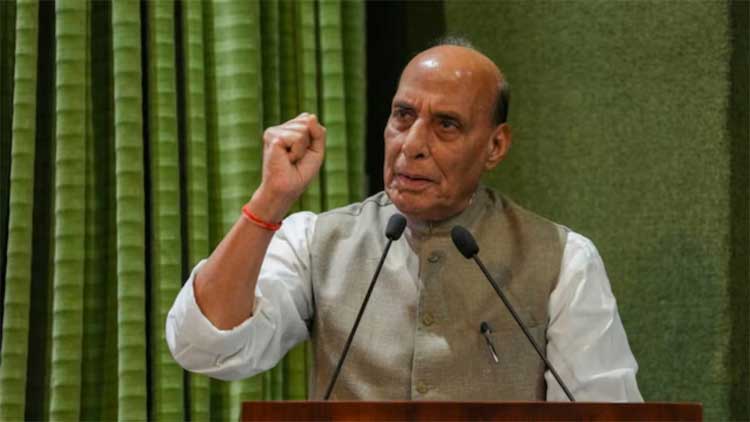
Defence Minister Rajnath Singh on Saturday said that India is fully “prepared for any eventuality,” responding to renewed concerns after U.S. President Donald Trump alleged that Pakistan has been secretly conducting nuclear tests.
In an interview with the Hindustan Times, Singh addressed speculation triggered by Trump’s remarks during a CBS interview earlier this week.
When asked about the alleged nuclear developments in Pakistan, Singh said India would not be alarmed by such reports.
“Those who want to test, let them; how can we stop them?” he said. “Whatever happens, we are prepared for any eventuality.”
Pressed on whether India might respond with its own tests if Islamabad proceeded, the minister replied,
“Let’s first see if they do it.”
Trump’s Claim of Pakistan’s ‘Secret Nuclear Tests’
Singh’s comments came days after President Trump announced that the United States would resume nuclear weapons testing after more than three decades, citing recent “underground tests by other countries.”
Without offering evidence, Trump named Pakistan as one such country, alleging that Islamabad continues to conduct secret nuclear experiments.
India’s Response
India’s Ministry of External Affairs (MEA) sharply reacted to Trump’s claims, reiterating that Pakistan’s nuclear programme has a long record of clandestine and illegal activity.
MEA spokesperson Randhir Jaiswal said:
“Clandestine and illegal nuclear activities are in keeping with Pakistan’s history—marked by decades of smuggling, export control violations, secret partnerships, the A.Q. Khan network, and further proliferation.”
Pakistan’s Denial
Islamabad has dismissed Trump’s allegations, with a senior official telling CBS News that Pakistan maintains a “unilateral moratorium” on nuclear testing.
“Pakistan was not the first to conduct nuclear tests and will not be the first to resume them,” the official said, reaffirming the country’s commitment to restraint despite not being a signatory to the Comprehensive Nuclear-Test-Ban Treaty (CTBT).
Comments are closed.