
Rajapaksa, Hasina, Oli: Unraveling the Digital Forces Behind South Asia’s Rapid Political Upheavals

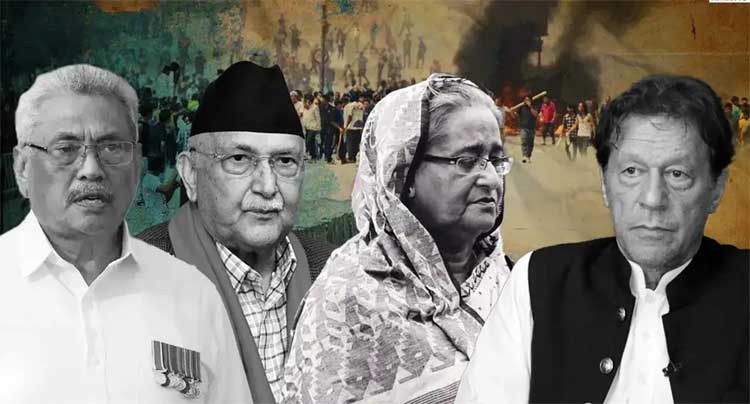
Recent analyses of youth-led movements in South Asia reveal a striking acceleration of political change in the digital age. While it took three months for public protests to unseat Sri Lanka’s Gotabaya Rajapaksa in July 2022, 15 days to challenge Bangladesh’s Sheikh Hasina in August 2024, Nepal’s K P Sharma Oli was forced out in just two days on September 9, 2025.
Despite their authoritarian tendencies, the intelligence agencies of all three countries failed to detect the uprisings before they erupted into on-ground chaos, resulting in loss of life and widespread disruption. Digital platforms—ranging from TikTok and Discord to Viber and Facebook—played a central role, often orchestrated by algorithms influenced by individuals or groups with global reach.
In Nepal, for example, political figures such as Kathmandu Mayor Balendra Shah and digital activist Rabi Lamichanne leveraged social media campaigns, alongside support from Western-funded NGOs, to mobilize the masses, culminating in the rapid ousting of Oli. Similar dynamics were evident in Sri Lanka and Bangladesh, underscoring how youth mobilization can bypass traditional power structures.
Geopolitical alignments added another layer of complexity. Rajapaksa, Hasina, and Oli were all perceived as pro-China leaders: Rajapaksa facilitated Chinese control over Hambantota port, Hasina planned access to Chittagong and Mongla ports, and Oli granted port access despite Nepal being landlocked. Yet, even just days before his ouster, Oli participated in a military parade in Beijing, illustrating how quickly public sentiment can shift beyond the control of even well-connected leaders and their foreign allies.
The rapidity of these uprisings demonstrates the limitations of traditional intelligence in the age of algorithms, AI, and deepfakes. While digital mobilization empowers youth, it also poses risks: abrupt regime change often leaves governance gaps, weakens institutions, and fuels cycles of chaos, as seen in the Arab Spring and the rise of extremist groups. Political experience, compromise, and long-term institution-building remain essential, yet are increasingly undervalued by digitally-connected youth seeking instant results.
Underlying these movements is widespread dissatisfaction with governance. High youth unemployment, systemic corruption, and the allure of Western lifestyles portrayed in media fuel disillusionment and drive political activism. In countries like Myanmar and Pakistan, similar unrest has been suppressed by military interventions, highlighting the precarious balance between youth sentiment and state stability.
For political leaders, these developments underline the need for direct engagement with citizens. Prime Minister Narendra Modi’s outreach to youth in India exemplifies how leaders can stay attuned to public sentiment, while policies promoting entrepreneurship and ease of doing business can mitigate reliance on government for employment.
Ultimately, perception often outweighs reality in today’s hyper-connected world. Governments must adapt by fostering transparent, responsive communication channels and leveraging modern tools to counter misinformation, recognizing that digital narratives now shape political landscapes as decisively as traditional governance.
Comments are closed.