
PM Modi’s 6-Point Agenda, Climate Finance Push, and US Boycott: Five Key Takeaways From the G20 Summit

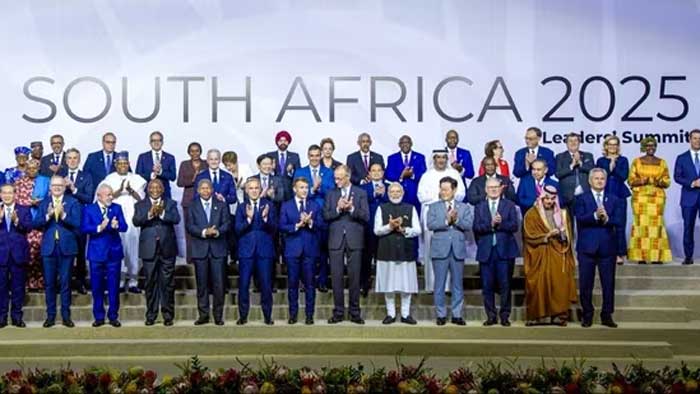
World leaders convened in Johannesburg on Saturday as the G20 Leaders’ Summit opened with South African President Cyril Ramaphosa pledging to uphold the bloc’s integrity and ensure that the development priorities of Africa and the broader Global South are reflected in its agenda, Reuters reported.
The three-day summit began on November 21, with Prime Minister Narendra Modi arriving a day earlier. Modi held bilateral talks with several global leaders, including Australian Prime Minister Anthony Albanese.
“Landed in Johannesburg for the G20 Summit-related engagements. Look forward to productive discussions with world leaders on key global issues,” PM Modi posted on X.
Modi Unveils Six-Point Agenda
PM Modi proposed six new G20-led initiatives aimed at addressing global challenges:
-
G20 Initiative on Countering the Drug-Terror Nexus
-
G20 Global Healthcare Response Team to create a pool of deployable medical professionals
-
G20 Africa-Skills Multiplier Initiative to support Africa’s workforce transformation
-
Global Traditional Knowledge Repository
-
G20 Open Satellite Data Partnership
-
Critical Minerals Circularity Initiative for sustainable resource management
G20 Passes Declaration Amid US Boycott
Despite objections and an official boycott ordered by US President Donald Trump, G20 members adopted a joint declaration on climate action and global governance.
The White House accused South Africa of “weaponizing” its presidency and pushing the declaration through without US input.
“President Ramaphosa is refusing to facilitate a smooth transition of the G20 presidency,” White House spokeswoman Anna Kelly said, adding that South Africa had ignored “consistent and robust US objections,” according to Reuters.
Trump has repeatedly criticised South Africa’s leadership, accusing it of pursuing “anti-White” policies and persecuting the Afrikaner minority. US Secretary of State Marco Rubio also skipped a G20 foreign ministers meeting in February, claiming the agenda focused solely on “DEI and climate change” and was not worth US taxpayer money.
Critical Minerals Framework Takes Centre Stage
The declaration places significant emphasis on establishing a G20 Critical Minerals Framework to ensure developing countries benefit fully from their mineral resources.
As demand increases due to digitalisation and clean-energy transitions, the framework aims to address underinvestment, low value addition, technological gaps, and environmental concerns in producer nations, particularly across the Global South.
“We recognise that… the demand for critical minerals will increase,” the declaration stated, adding that producer countries have yet to realise the full economic benefits.
Push for Scaling Up Climate Finance
Coming a day after COP30 concluded with a modest climate deal, the G20 declaration called for rapidly scaling up global climate finance “from billions to trillions.”
Leaders highlighted stark energy-access inequalities, especially in Africa, and urged increased investment in sustainable and resilient energy systems.
The document also underscored the need to strengthen early-warning systems for climate-related disasters.
Ukraine Conflict Dominates Sidelines
Ukraine received only a brief mention in the 30-page declaration, but Western leaders maintained focus on the war during separate meetings.
The declaration calls for “just, comprehensive, and lasting peace” in Ukraine, Sudan, the Democratic Republic of Congo and the “Occupied Palestinian Territory.”
Meanwhile, European leaders issued a joint statement addressing the leak of US President Trump’s controversial 28-point peace plan for Ukraine, Bloomberg reported. They indicated that further work was needed and said they were coordinating closely with Kyiv and Washington.
Comments are closed.