
PM Modi to meet delegations after world tour next week

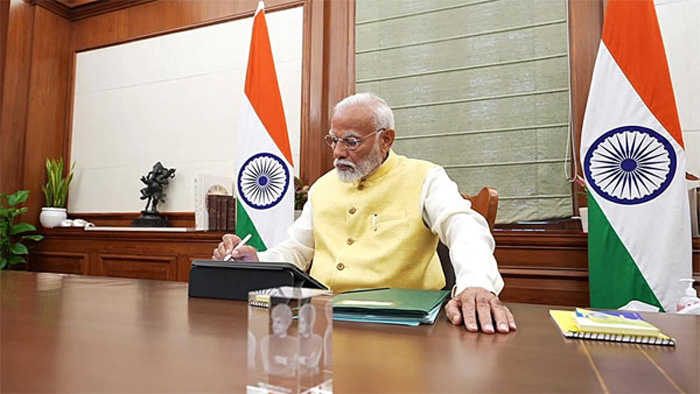
Prime Minister Narendra Modi is likely to meet the seven multi-party delegations, which are currently touring key international capitals to underscore India’s zero-tolerance for terrorism and New Delhi’s “new normal” against the menace, sometime next week, people aware of developments said on Monday.
According to the people cited above, the date for Modi’s meeting is yet to be finalised but it might happen on June 9 or 10. Before the PM meets all seven delegations, they will debrief external affairs minister S Jaishankar in a process starting from Tuesday with the team led by Bharatiya Janata Party leader Baijayant ‘Jay’ Panda, the people added.
Panda’s delegation, which left Delhi on May 24, is set to be the first to return home after visiting Saudi Arabia, Kuwait, Bahrain and Algeria. The meeting with Jaishankar is scheduled at 2.30pm on Tuesday.
The delegation comprises BJP leaders Nishikant Dubey, Phangnon Konyak, Rekha Sharma, All India Majlis-e-Ittehadul Muslimeen chief Asaduddin Owaisi, nominated Rajya Sabha member Satnam Singh Sandhu, former minister Ghulam Nabi Azad, and former foreign secretary Harsh Shringla.
The PM’s decision to meet all the delegations is a significant step as top-ranking functionaries suggested that the main idea to send the teams across the globe after Operation Sindoor came from the PM. It will be the first interaction between the PM and the delegations, which began leaving Delhi on May 21.
The multi-party delegations—comprising 59 lawmakers, in addition to former diplomats — have already covered a bulk of their itinerary of 33 countries, including the European Union.
The leaders, briefed by foreign secretary Vikram Misri before leaving Delhi, have focused on exposing Pakistan’s duplicity on combating terror by showing pictures of the country’s army general attending funeral of terrorists killed during Operation Sindoor and the discovery of 9/11 accused Osama Bin Laden in Abbottabad, and underlined how repeated peace initiatives by New Delhi met with disappointment and more attacks, people familiar with the matter said.
All seven delegations – headed by senior Congress leader Shashi Tharoor; Bharatiya Janata Party leaders Ravi Shankar Prasad and Panda; Janata Dal (United) leader Sanjay Jha, Dravida Munnetra Kazhagam leader Kanimozhi Karunanidhi, Nationalist Congress Party (Sharadchandra Pawar) leader Supriya Sule, and Shiv Sena leader Shrikant Shinde – have met parliamentarians, ministers, government officials and policy makers to exchange views on furthering cooperation on counterterrorism and combating radicalism, especially after the April 22 Pahalgam terror attack that left 26 civilians dead.
The Indian delegations spoke about major terror attacks sponsored by Pakistan, how Islamabad refused to act even after New Delhi provided clinching evidence of photos, DNA samples and call records in the aftermath of the 2008 Mumbai attacks, and pointed out that all major international terror attacks including the 9/11 World Trade Center attacks and the 2005 London bombing had direct or indirect links to Pakistan, said the people cited above.
Two of the delegations – one to Russia and another to Japan – concluded their visits on Saturday with “constructive meetings”, said the people cited above.
Operation Sindoor was India’s direct military response to the April 22 terror strike at Pahalgam in Kashmir that killed 26 civilians in what was the worst attack on civilians since the 26/11 Mumbai strikes.
India launched the operation in the early hours of May 7, bombing nine terror camps in Pakistan and Pakistan-occupied Kashmir (PoK). The pre-dawn strikes — which killed at least 100 terrorists — sparked a series of attacks and counter attacks across the western border, involving fighter jets, missiles, armed drones, and fierce artillery and rocket duels. In one such counterattack on the night of May 9-10, the air force struck targets at 13 Pakistani air bases and military installations. After four days of fighting, military hostilities were stopped on May 10 as the two nations reached an understanding.
The move to send political delegations abroad started on May 17, roughly a week after India and Pakistan agreed to an understanding to cease hostilities.
In Algiers, Panda said that India’s appeal to place Pakistan back on the Financial Action Task Force (FATF) grey list was gaining significant resonance globally, emphasising the role of illicit financing in fuelling terrorism.
“Pakistan is not interested in improving itself or helping its people… They have diverted the money for terrorism and its army and looted it… Terrorism is fuelled by two things. One is ideology and the other is illicit finance… Ideology-wise, these Islamic countries have taken a strong stand… They do not permit any kind of fundamentalism from their soil… Financing part is the other aspect,” Panda said.
In Paris, former Union minister M J Akbar asserted India’s clear and thought-through “no first use” doctrine on nuclear weapons and said, “Pakistan is a military state, it is no longer a civilian state. And a military state has a vested interest in conflict because conflict justifies its presence… Now, it sometimes thinks it can provide a nuclear shelter to terrorists. The Prime Minister (Modi) has made it very clear that there can be no nuclear blackmail.”
In Tokyo, Trinamool Congress lawmaker Abhishek Banerjee said, “If terrorism is a rabid dog, Pakistan is a vile handler…We are here to share the message and the truth that India refuses to bow down. We will not kneel to fear. I belong to a political party that is in the Opposition. It is in the public domain that I have said that Pakistan needs to be taught a lesson in the language they understand,” he said.
Comments are closed.