
Organisational Frequency By Vinay Pasricha
A new doctrine for hiring in the age of intelligent discovery - A must-read book for organisations

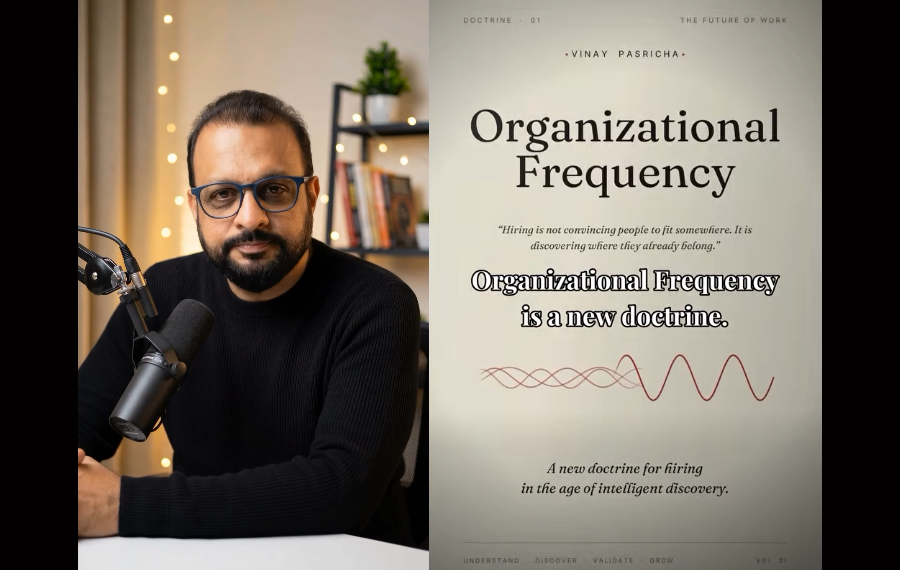
In today’s rapidly evolving corporate environment, organisations are no longer measured only by balance sheets, infrastructure, or market valuation. Increasingly, the true strength of an organisation lies in its frequency — the invisible energy created by leadership, culture, communication, ethics, and collective purpose.
“Organisational Frequency” refers to the emotional, intellectual, and cultural vibration at which an institution operates. Every organisation emits a frequency that influences employees, customers, partners, and society at large. High-frequency organisations inspire innovation, trust, collaboration, and long-term sustainability, while low-frequency organisations often struggle with internal conflict, fear-driven management, stagnation, and high attrition.
At the heart of organisational frequency is leadership. Leaders set the emotional tone of the workplace. A visionary leader creates confidence and clarity, whereas uncertain leadership generates anxiety and confusion. Employees unconsciously absorb and reflect the energy projected by management. Therefore, leadership behaviour directly impacts organisational productivity and morale.
Communication is another vital component. Transparent communication builds trust and alignment. When employees feel heard, respected, and informed, the organisational frequency rises naturally. In contrast, secrecy, politics, and negativity lower collective motivation and weaken institutional harmony.
Culture also determines frequency. Organisations that value integrity, inclusivity, creativity, and employee well-being create environments where individuals thrive. Such workplaces attract talent, retain commitment, and encourage innovation. High-frequency cultures promote collaboration over competition and purpose over mere profit.
Every company carries a frequency. Every person carries their own. Great performance happens when the two resonate. Most bad hires are not bad people; they are mismatched frequencies, miscast in the wrong environment, says Vinay Pasricha
“Organisational Frequency” by Vinay Pasricha is now available on Amazon

Another important factor is organisational intent. Companies driven solely by financial gain may achieve temporary success, but organisations aligned with a larger mission often build stronger emotional connections with stakeholders. Purpose-driven institutions generate loyalty because people seek meaning in their professional lives.
Technology and infrastructure can enhance efficiency, but they cannot replace human energy. Even the most advanced systems fail in environments dominated by fear, ego, or distrust. Conversely, organisations with positive energy often overcome resource limitations through teamwork, resilience, and shared vision.
In the modern era, organisational frequency has become a strategic advantage. Customers increasingly prefer brands that reflect authenticity and responsibility. Employees seek workplaces that support growth and emotional well-being. Investors value ethical and sustainable enterprises. Thus, frequency is no longer abstract philosophy — it is a measurable business asset.
To elevate organisational frequency, institutions must invest in leadership development, emotional intelligence, employee engagement, ethical governance, and meaningful communication. Small changes in attitude, respect, and intention can transform workplace energy dramatically.
Ultimately, organisational frequency defines how people feel when they engage with an institution. It determines whether employees merely work for a company or genuinely believe in it. In a world driven by human connection, the organisations with the highest frequency will lead the future.
Comments are closed.