
Nvidia Becomes First Company to Hit $4 Trillion Market Value

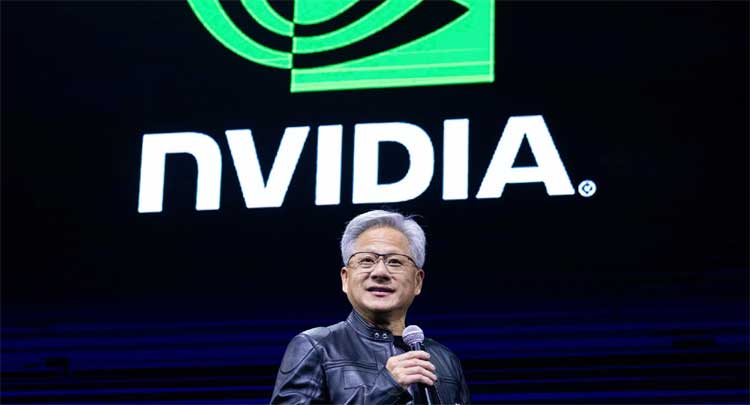
Nvidia on Wednesday became the first company to briefly touch a $4 trillion market valuation, underscoring Wall Street’s growing conviction that artificial intelligence is reshaping the global economy.
Shares of the California-based chipmaker jumped as high as $164.42 shortly after markets opened, before paring gains to close at $162.88 — up 1.8% on the day and just shy of the milestone mark.
“The market has an incredible certainty that AI is the future,” said Steve Sosnick, chief strategist at Interactive Brokers. “Nvidia is certainly the company most positioned to benefit from that gold rush.”
Nvidia’s market cap now exceeds the GDP of nations like France, the UK, or India, reflecting surging investor confidence in the company’s leadership in AI hardware. Under CEO Jensen Huang, Nvidia has ridden the AI wave with its cutting-edge graphics processing units (GPUs) powering breakthroughs in generative AI, robotics, and automation.
The stock’s rise has helped propel broader market gains, especially for the tech-heavy Nasdaq, which closed at a fresh record Wednesday. The rally comes despite geopolitical uncertainties, including fresh tariff announcements by President Donald Trump. Markets appear to have stabilized after Trump rolled back the harshest of his earlier trade threats.
“Markets have walked back from a worst-case scenario in terms of tariffs,” said CFRA analyst Angelo Zino.
Still, challenges remain. Nvidia faces ongoing U.S. export controls restricting sales of advanced chips to China. Yet, a May agreement to build AI infrastructure in Saudi Arabia — signed during Trump’s state visit — demonstrated how the company could benefit from U.S. trade diplomacy.
Riding AI Momentum, Despite Setbacks
Nvidia’s path to $4 trillion has been marked by explosive growth. Its shares are up over 21% so far in 2025, outpacing the Nasdaq’s 6.7% gain. The company recently launched its Blackwell architecture, enabling “real-time digital twins” that promise major efficiency gains in sectors like aerospace, manufacturing, and healthcare.
However, the meteoric rise hasn’t been without turbulence. In early 2025, Nvidia’s market value plunged by $600 billion in a single session following the emergence of China’s DeepSeek — a low-cost, high-performance AI model that challenged U.S. tech dominance.
While some feared DeepSeek could upend Nvidia’s dominance, the company has since regained investor confidence. Zino noted that Nvidia has maintained its lead, especially in supplying the hardware backbone for advanced “AI agents” — next-generation models capable of reasoning and inference beyond basic text generation.
“The demand landscape has improved for these more complex reasoning models,” Zino said, citing recent earnings and an upbeat industry outlook.
Boom Times with a Shadow
In its most recent quarter, Nvidia reported nearly $19 billion in earnings, even after absorbing a $4.5 billion hit from U.S. export controls. Analysts say the company’s resilience highlights how central it remains to the AI revolution — with Microsoft, Google, Meta, and Amazon all racing to integrate Nvidia technology into their AI initiatives.
A recent UBS survey found Nvidia widening its lead among tech executives, reinforcing its central role in the sector.
Still, the rapid adoption of AI isn’t without fallout. Companies like Ford, JPMorgan Chase, and Amazon have begun publicly acknowledging the likelihood of white-collar job losses, a shift that’s adding a layer of unease to the tech boom.
For now, Nvidia remains the emblem of AI optimism — even if its $4 trillion crown was momentary.
Comments are closed.