
Netanyahu Urges Regional Push to Expel Hamas After UN Backs Trump Peace Plan

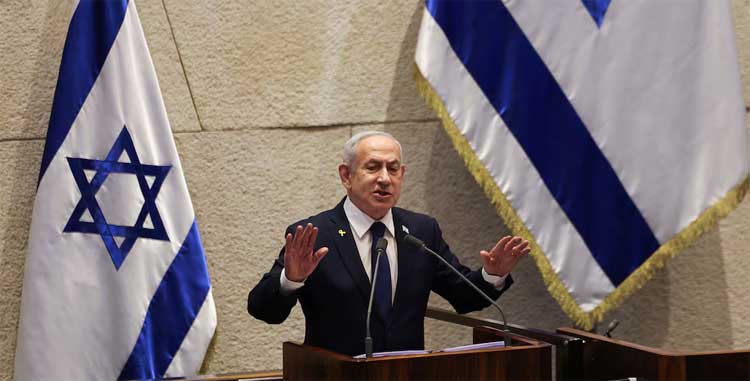
Israeli Prime Minister Benjamin Netanyahu on Tuesday called for Hamas to be “expelled from the region,” a day after the UN Security Council endorsed President Donald Trump’s multi-phase plan to end the war in Gaza — a proposal that offers the militant group amnesty under certain conditions.
Netanyahu had publicly supported the plan during his White House visit in late September. But his latest remarks suggest emerging differences with Washington over how to implement the proposal, which Hamas has also partly rejected.
Diplomats say entrenched positions on both sides have slowed progress on the initiative, which lacks clear timelines or enforcement mechanisms but nonetheless enjoys broad international support.
Following the UN vote, Netanyahu posted a series of messages on X, praising Trump and reiterating Israel’s belief that the plan could bring “peace and prosperity” through the “full demilitarization, disarmament and deradicalization of Gaza.”
“Israel extends its hand in peace and prosperity to all of our neighbors,” he wrote, urging regional countries to “join us in expelling Hamas and its supporters from the region.”
Asked to clarify the term “expelling,” a spokesperson said it referred to ensuring “there is no Hamas in Gaza, as outlined in the 20-point plan,” and that Hamas would no longer be able to govern Palestinians in the territory.
Plan Does Not Call for Hamas’ Removal
Despite Netanyahu’s comments, Trump’s plan does not mandate Hamas’ expulsion. Instead, it includes a clause granting amnesty to Hamas members who renounce violence and decommission their weapons, and safe passage to those who wish to leave for third countries.
The plan requires Hamas to relinquish any role in Gaza’s governance, but it does not explicitly call for the group to disband or exit the territory.
It also references potential reforms within the West Bank-based Palestinian Authority, which could eventually create “conditions for a credible pathway to Palestinian self-determination and statehood.”
Netanyahu, however, reiterated on Sunday that his government opposes Palestinian statehood — a stance sharpened by pressure from far-right coalition partners reacting to a US-backed statement supporting a path toward Palestinian independence. He also remains firmly opposed to any Palestinian Authority role in post-war Gaza.
UN Authorizes Multinational Force for Gaza
The Security Council resolution approves the deployment of a multinational force, envisioned in Trump’s plan as a temporary stabilizing presence in Gaza. The text also invites member states to join a “Board of Peace” that would oversee reconstruction and economic recovery in the enclave.
Hamas criticized the resolution, saying it fails to meet the “political and humanitarian rights” of Palestinians, who reject any form of international guardianship over Gaza. The group said any foreign force must remain strictly on Gaza’s borders, operate under UN supervision and avoid actions — such as disarmament efforts — that could compromise its neutrality.
Reham Owda, a political analyst from Gaza, said Hamas’ statement amounted to an objection rather than an outright rejection, and reflected an effort to negotiate terms for the force’s deployment and the operations of the Board of Peace.
A ceasefire, part of Trump’s multi-phase plan, took effect on October 10. Israel has partially withdrawn its troops but continues to control 53% of Gaza, and both sides have accused each other of violating the truce.
Abu Abdallah, a displaced businessman in central Gaza, said many Palestinians would welcome an international force if it guaranteed a full Israeli withdrawal.
“Hamas can’t decide our fate alone,” he said. “But we also don’t want to get rid of one occupation — Israel — only to end up with an international one.”
Comments are closed.