
Netanyahu Says Gaza War Won’t End Until Hamas Disarmed, Territory Demilitarized

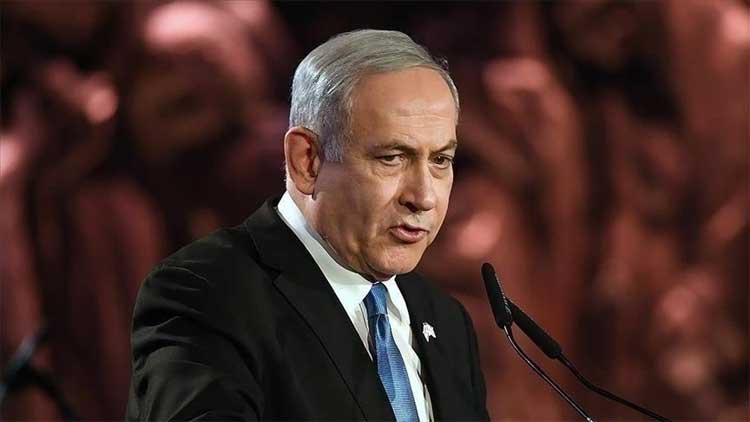
Israeli Prime Minister Benjamin Netanyahu said on Saturday that the war in Gaza would not conclude until Hamas was fully disarmed and the Palestinian territory demilitarized.
His remarks came as Hamas’s armed wing, the Ezzedine Al-Qassam Brigades, handed over the remains of two more hostages under a US-brokered ceasefire agreement. Netanyahu’s office said the bodies were transferred to Israeli forces in Gaza by a Red Cross team and would be identified in Israel.
The return of deceased hostages has become a key sticking point in implementing the first phase of the truce. Israel has linked the reopening of the Rafah border crossing to Hamas fulfilling its commitments on returning the bodies.
Netanyahu stressed that completing the ceasefire’s second phase — the disarming of Hamas and the demilitarization of Gaza — was essential to ending the conflict. “When that is successfully completed — hopefully in an easy way, but if not, in a hard way — then the war will end,” he said in an interview with Israel’s Channel 14.
Hamas has rejected the disarmament demand and has moved to reassert control over Gaza since the fighting paused.
The US State Department said Saturday it had “credible reports” that Hamas was planning an imminent attack against civilians in Gaza, warning such an act would violate the ceasefire. “Should Hamas proceed with this attack, measures will be taken to protect the people of Gaza and preserve the integrity of the ceasefire,” it said, without specifying details.
Rafah Crossing to Remain Closed
Under the truce brokered by US President Donald Trump, Hamas has so far released all 20 living hostages and the remains of 10 others — nine Israelis and one Nepalese. In exchange, Israel has freed nearly 2,000 Palestinian prisoners and returned 135 bodies of Palestinians since the ceasefire began on October 10.
Hamas said it needs additional time and technical assistance to locate and recover remaining bodies buried beneath Gaza’s rubble. Netanyahu’s office said the Rafah crossing would “remain closed until further notice,” adding its reopening would depend on Hamas’s compliance with the deal. Hamas warned the closure would cause “significant delays” in retrieving and transferring remains.
Massive Humanitarian Challenge
UN humanitarian chief Tom Fletcher, visiting northern Gaza on Saturday, described the scale of destruction as “a wasteland” and said aid agencies faced a “massive, massive job.”
“We have a 60-day plan to surge in food, deliver a million meals a day, rebuild the health sector, bring in tents for the winter, and get hundreds of thousands of children back to school,” Fletcher told AFP.
He said many displaced residents had begun digging latrines among the ruins of their destroyed homes.
Violence Persists Despite Truce
Despite the ceasefire, sporadic violence has continued. Gaza’s civil defense agency said Israeli forces fired two tank shells at a bus in Gaza City, killing nine members of the Shaaban family — two men, three women, and four children. Two others were missing, believed killed in the blast.
At Al-Ahli Hospital, relatives wept over bodies wrapped in white shrouds. “My daughter, her children and her husband; my son, his children and his wife were killed. What did they do wrong?” asked Umm Mohammed Shaaban, the family’s matriarch.
The Israeli military said it targeted a vehicle that approached the “yellow line” — the boundary to which its forces had withdrawn under the ceasefire — but gave no casualty figures.
Comments are closed.