
Netanyahu Floats ‘Hexagon’ Alliance Ahead of Modi’s Israel Visit; What’s Behind the Push for India?

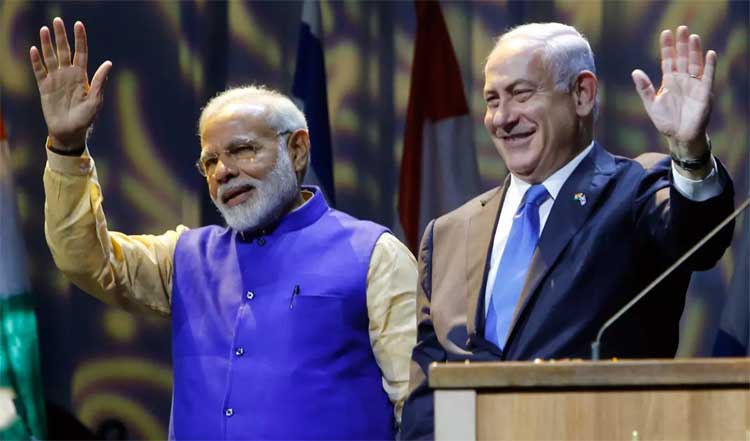
As Prime Minister Narendra Modi prepares for his second visit to Israel, attention has turned to remarks by Israeli Prime Minister Benjamin Netanyahu suggesting a broader strategic vision that includes India. Netanyahu recently outlined what he described as a “hexagon” of alliances spanning the Middle East and beyond, naming India among the key partners.
Modi’s two-day visit, scheduled from February 25 to 26, is expected to focus on bilateral priorities, including technology, trade, and security cooperation. The prime minister is also set to address the Knesset, Israel’s parliament.
Netanyahu’s ‘hexagon’ concept
Speaking at the start of a weekly cabinet meeting, Netanyahu characterized India as a “global power” and referred to Modi as a personal friend. He said Israel was working toward “an entire system, essentially a ‘hexagon’ of alliances around or within the Middle East.”
Netanyahu indicated the framework would involve India alongside Arab nations, African nations, Mediterranean partners such as Greece and Cyprus, and other Asian countries. He presented the idea as a strategic alignment among countries that, in his words, share common perspectives on regional challenges.
While the description overlaps in part with existing connectivity initiatives such as the India-Middle East-Europe Economic Corridor (IMEC), Netanyahu framed the proposal primarily in geopolitical and diplomatic terms rather than as an economic arrangement.
No formal backing
None of the governments mentioned by Netanyahu have publicly endorsed the “hexagon” proposal. His comments have also sparked debate internationally.
Greece and Cyprus, cited by Netanyahu, are members of the International Criminal Court (ICC), which has issued an arrest warrant against him over alleged war crimes related to the Gaza conflict. As ICC members, those countries are bound by the court’s legal framework.
Netanyahu’s remarks have drawn criticism elsewhere in the region. Pakistan’s Senate, for instance, passed a resolution condemning what it described as Israeli efforts to build alliances perceived as targeting specific states, according to media reports.
India’s strategic calculus
How India views Netanyahu’s concept remains unclear. New Delhi has traditionally pursued a policy of strategic autonomy, avoiding formal participation in rigid geopolitical blocs while maintaining relations with diverse global and regional actors.
India’s longstanding ties with countries across West Asia — including Iran and Gulf states — as well as the region’s economic importance for India, are central considerations. Millions of Indian nationals work in Gulf countries, contributing significantly to remittance flows.
Analysts have suggested that India’s interests in its partnership with Israel are largely centered on defence, technology, and innovation rather than alignment with any single regional strategy.
Agenda for Modi’s visit
During Modi’s visit, India and Israel are expected to advance cooperation in high-technology sectors. Netanyahu has highlighted potential collaboration in areas such as artificial intelligence and quantum technologies.
The visit itinerary includes participation in an innovation-focused event in Jerusalem, a joint visit to Yad Vashem, and meetings with Israeli leaders, including President Isaac Herzog.
India–Israel ties have steadily expanded since Modi’s landmark 2017 trip — the first by an Indian prime minister to Israel — followed by Netanyahu’s 2018 visit to India. Both sides have repeatedly emphasized growing cooperation in economic, diplomatic, and security domains.
Comments are closed.