
‘Mother of All Deals’ With India Almost Sealed, Says EU Leader Ahead of Republic Day Summit With Modi

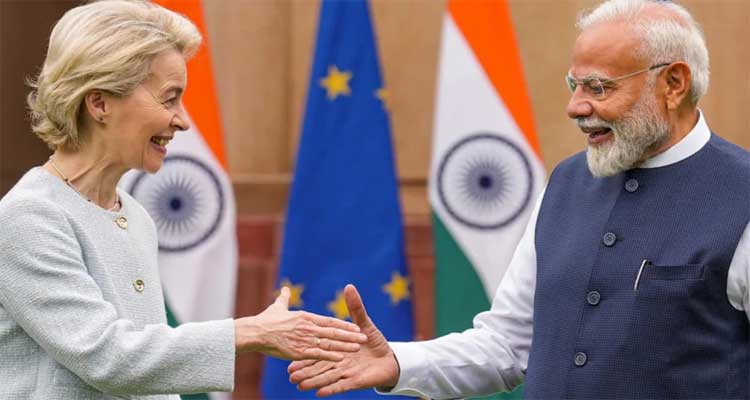
India and the European Union are on the cusp of a “historic trade agreement” that would create a combined market of nearly 2 billion people and account for almost a quarter of global GDP, European Commission President Ursula von der Leyen said on Tuesday at the World Economic Forum in Davos.
Her remarks come just days before her visit to New Delhi.
“I will travel to India. There is still work to do. But we are on the cusp of a historic trade agreement. Some call it the mother of all deals,” von der Leyen said, underscoring the scale and strategic importance of the proposed pact.
She highlighted the significance of the agreement at a time when US President Donald Trump has increasingly used tariffs against both India and European countries to push them into positions favoured by Washington.
“It is time to seize this opportunity and build a new independent Europe,” von der Leyen said, referring to current “geopolitical shocks” and how the 27-nation bloc is responding to them.
Von der Leyen and European Council President Antonio Costa will be in India from January 25 to 27 as chief guests for Republic Day celebrations and will hold summit talks with Prime Minister Narendra Modi. The two sides are expected to announce the conclusion of negotiations on the long-awaited India–EU Free Trade Agreement (FTA) at the summit on January 27.
“And, crucially, that would provide a first-mover advantage for Europe with one of the world’s fastest-growing and most dynamic continents,” von der Leyen said, adding that Europe wants to engage with the growth centres of today and the economic powerhouses of this century.
“From Latin America to the Indo-Pacific and far beyond, Europe will always choose the world. And the world is ready to choose Europe,” she said in her televised address.
What the FTA means for India and the EU
The European Union is already India’s largest trading partner, with bilateral trade in goods reaching $135 billion in the 2023–24 financial year. The FTA is expected to significantly deepen these ties.
India and the EU first launched FTA negotiations in 2007, but talks were suspended in 2013 due to differences in ambition. Negotiations were relaunched in June 2022. The renewed push comes amid growing unease over trade and tariff policies pursued by the Trump administration, which have affected both India and the EU.
“The world may be very different today, without any question. But I believe the lesson is very much the same—that geopolitical shocks can, and must, serve as an opportunity for Europe,” von der Leyen said.
Defence pact also on agenda
Beyond the FTA, India and the EU are expected to unveil a defence framework pact and a new strategic agenda during the January 25–27 summit. The two have been strategic partners since 2004 and are working toward a joint comprehensive strategic vision to guide relations from 2026 to 2030.
In her Davos address, von der Leyen also referred to wider geopolitical challenges, including tensions over Greenland.
“In my view, the seismic change we are going through today is an opportunity—indeed, a necessity—to build a new form of European independence,” she said. “This need is neither new nor merely a reaction to recent events.”
On ties with the US and Ukraine
Addressing transatlantic relations, von der Leyen said Europe views Americans not just as allies, but as friends, warning that a downward spiral in relations would only benefit shared adversaries.
Referring to the Russia–Ukraine war, she noted that the conflict is approaching its fourth year, with no sign of Russia seeking peace.
“This must end. We all want peace for Ukraine,” she said. Acknowledging President Trump’s role in pushing the peace process, she added that the EU would work closely with the United States and agreed that Ukraine must approach any negotiations from a position of strength.
Comments are closed.