
Locals say COP30 upgrades sideline Belém’s poorest as heat, housing costs and flood risks worsen

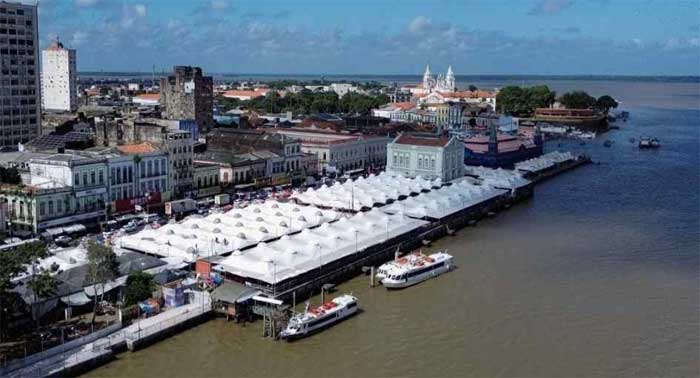
The 17th-century Presépio Fort offers a great view of old and new Belém. Small wooden boats sail back and forth. The strikingly blue Ver-o-Peso fish hall seems even bluer in the morning sun.
Next door to Ver-o-Peso, dozens of stands sell açai with fried fish, souvenirs and a stunning variety of fruits, nuts and herbs from the Amazon Rainforest. The grand Belle Epoque mansions are a far cry from the residential towers piercing the sky and the urban slums located farther south.
From Nov. 10-21, this setting will host the COP30 climate summit and more than 50,000 visitors. Following summits in Dubai and Baku — both cities intimately linked with the oil industry — there was a sense of hope and relief among environmentalists when Belém, the capital of the Amazonian state of Pará, was announced in May 2023 as the 2025 host.
Known as the “gateway” to the Amazon, Belém would be able to attract people’s attention to the plight and potential of the rainforest, which plays a vital role in keeping the average global temperature rise under 1.5° Celsius (2.7° Fahrenheit), as stipulated in the 2016 Paris Agreement.
In contrast with the last two “oil COPs,” the upcoming summit has been dubbed the “forest COP.” However, while Belém is located northeast of the Amazon Rainforest, in the delta of the Guamá and Acará rivers, experts and citizens who spoke with Mongabay questioned whether visitors and authorities will have a unique chance to get a glimpse of the rainforest or of an urban metropolis struggling with traffic, sewage, floods and shade — as many in the world.
A striking snapshot of this contradiction was revealed in October by Brazilian news outlet Sumaúma. The report showed that 55% of Belém’s inhabitants live on streets without a single tree; the national average is 34%. The Amazonian city is the sixth-least-forested capital in Brazil, according to official data. Peripheral neighborhoods like Miramar have 98% of their population residing on streets without a tree, while in wealthier central neighborhoods, such as Nazaré (84%), Umarizal (77%) and Batista Campos (73%), most residents live on streets lined with trees.
Belém is a synthesis of Pará, which for years has witnessed some of Brazil’s highest deforestation rates and is home to Brazil’s illegal gold mining capital, Indigenous lands and rivers plagued with mercury, land conflicts and major deforestation schemes.
In the months leading up to the conference, many of those issues were debated, including skyrocketing prices of accommodations during COP30. According to the Reuters newswire, several nations have considered not sending delegates to Belém because of high hotel fares.
However, the hotel crisis and environmental crimes are far from the only issues about Belém’s COP. The event has forced Belém to take a hard look at itself in the mirror.
Take me to the river
Prior to the European invasion, Belém was a large Tupinambá settlement, driven by its rivers.
“Geographically and historically, Belém has always been a river city,” Ana Claudia Cardoso, associate professor at the School of Architecture and Urbanism at the Federal University of Pará (UFPA), told Mongabay.
The first Portuguese colonists aimed to exploit the region by establishing plantations, but they soon realized it was easier and more profitable to extract products from the forest, like the Indigenous people did and had always done.
“For hundreds of years, fish, fruits and other forest products were brought to the market in Belém and shipped to other parts of Brazil, the Caribbean and Europe,” Cardoso said at the UFPA campus on the bank of the Guamá River.
As Belém became economically relevant, the Portuguese started strengthening the city’s infrastructure. One of the main examples was the Presépio Fort, Portugal’s main power base in the north of its crown colony.
“The city never had an industrial revolution,” she continued. “It didn’t need one. It had the forest, the river and the market. Everything changed in the 1950s when the national road network reached the north. Belém turned its back on the river.”
From 1964, with the military dictatorship in Brazil, more roads followed. Generals viewed — and many still view — the Amazon as a territory that needed to be occupied by urban development in order to be “protected” from foreign invasion. The view, widely considered a conspiracy theory by historians, led to large infrastructure projects, such as the Trans-Amazonian Highway. And it would not take long before the roads brought land-grabbers, farmers, ranchers and illegal miners.
From being the market of the Amazon, Belém became a market for products from Brazil’s industrialized south.
“People were no longer able to live off the land or were forced off their land,” Cardoso said. “They moved to the city to look for work. Especially in the 1980s, Belém saw a huge influx of people.”
Floods and favelas
In 1950, some 250,000 lived in the city. Today, Belém is home to nearly 1.4 million people, while the greater metropolitan area is home to 2.5 million people.
According to official data from 2022, 57% of the city’s inhabitants live in so-called baixadas, up from 52% in 2010.
Derived from the Portuguese word for “lowered,” baixadas refer to low-lying, densely populated, low-income areas that often have only limited access to public facilities such as sewer and electricity systems. In other parts of Brazil, these communities are known as favelas.
“People have always lived on the várzea,” or floodplain, Cardoso explained. “But never so many. Today, the river banks are full. The river no longer has space to roam.”
With 40% of urban Belém below sea level, most of the city’s inhabitants are familiar with flooding. With every heavy rain, roads become rivers and water enters homes.
The beautiful UFPA campus overlooking the Guamá River is no exception. Blessed with ample vegetation and few waterways running through, the campus lies at an altitude of 3.6 meters (11.8 feet).
That’s higher than most of the city, and normally, some 100 kilometers (62 miles) away from the ocean, the tide in Belém doesn’t exceed 3.4 m (11.2 ft). However, in April 2024, heavy rainfall in combination with high tide caused the river to rise by 3.8 m (12.5 ft), which flooded the campus.
“The water retreated within a few hours, so it didn’t do much damage,” Cardoso said. “But it was a warning of things to come. If the ‘perfect storm’ of Porto Alegre were to hit Belém, some 60% of the city would be underwater.”
Torrential rains in April and May 2024 caused massive flooding in the southern state of Rio Grande do Sul. More than 200 people were killed and hundreds of thousands lost their homes.
The state capital of Porto Alegre was particularly hard-hit. At one point, the level in Guaíba Lake rose by 5.3 m (17.4 ft), beating the 1941 record and flooding a heavily populated area of the city, home to 1.3 million people, for three weeks.
Water works
In June, the municipal risk reduction plan (PMRR) issued a report concluding that 301 areas in Belém are at risk of flooding. They are mostly located near the river basins that run through the city, whereas 88 areas, mostly found on the city’s 42 islands, are at risk of erosion.
Originally from the south of Brazil, Patricia Souza has lived in Belém for about six years and has no intention of leaving. She loves the cultural mix of the city, as reflected in its people, music and cuisine.
Sol used to live in Baixada do Marco in the south of Belém but recently moved to a home on slightly higher grounds closer to the city center.
“I loved living in Baixada do Marco,” the 35-year-old graphic designer said. “The baixadas are often very close-knit communities, as many people stem from the same region outside the city.”
Yet, as the state is largely absent in the baixadas, they suffer from a lack of public services. It’s the main reason she eventually moved out.
“My house was overlooking a drainage canal,” Souza said. “The problem is that most sewage goes into the canal, which produces a stench, especially when it’s hot. And with heavy rainfall, the canal would always overflow.”
A 2023 study by the Instituto Trata Brasil showed that 76.8% of Belém’s inhabitants had access to potable water, while 17.1% were connected to a sewage system and 3.6% of the city’s sewage was treated.
With COP30 as a catalyst, Belém has resembled a giant construction site for the past two years. The federal government earmarked some 4.8 billion reais ($891 million) to improve the city’s infrastructure.
On Aug. 4, the COP30 organizing committee reported in a press release that eight projects had been completed, while 37 were still underway. They include, among other things, refurbishing the Ver-o-Peso market, repaving 88.7 km of roads (55 mi), building two parks, constructing sewage treatment plants and rehabilitating 13 drainage canals across four of the city’s main river basins. Especially the latter concerns the city’s low-income areas.
“More than just hosting a global event, Belém is being prepared for the future,” the press release stated. “The infrastructure projects are part of a long-term strategy to leave a meaningful legacy for the city and its residents.”
Green legacy
Some residents feel the investments in Belém’s future well-being have not been evenly divided over the rich and poor parts of the city.
“Most money goes to the chic part of town,” said history teacher Raimundo de Oliveira, who lives in Guamá. With some 100,000 inhabitants, Guamá is the most densely populated area of Belém, located some 5 km (3 mi) from the old city center.
“In Guamá, they are only working on draining, cleaning and enlarging the canals,” he told Mongabay on Aug. 20. “The works haven’t been completed yet, and I don’t think they will be when the COP30 starts in November.”
Oliveira is not alone in criticizing the alleged uneven distribution of public money. Brazilian news outlet Agência Pública reported how cleaning up the Doca Canal and building a new sewage treatment plant benefits the upscale neighborhood of Reduto, while the baixada of Vila da Barca is left with the waste.
Another project is the construction of a four-lane highway, a project that cuts through the Belém Environmental Protection Area (APAB), fragmenting one of the last remaining patches of rainforest in the city.
Comments are closed.