
Lightning Quietly Kills 320 Million Trees a Year—And It’s Changing Our Forests and Climate

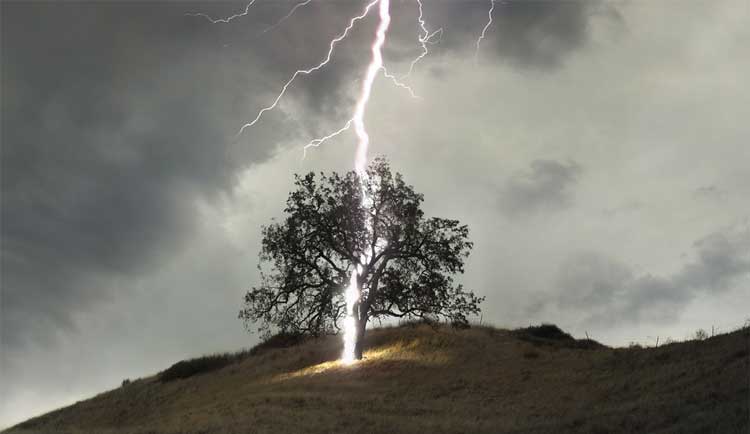
While wildfires often dominate headlines with their dramatic destruction, lightning strikes are silently killing an estimated 320 million trees each year—many without a trace.
Unlike firestorms that leave behind scorched landscapes, lightning typically kills trees slowly and invisibly, frying them from the inside out and leading to quiet decay over months or years. Now, for the first time, scientists have quantified the true scale of this hidden threat—and it’s far greater than anyone imagined.
The Silent Killer in the Forest
A new study by researchers at the Technical University of Munich has created the first global model of lightning-induced tree deaths. By integrating satellite observations, field reports, and global lightning frequency data, they discovered that lightning directly kills more than 320 million trees annually. That number doesn’t even account for trees lost in fires triggered by lightning, only those felled by the strike itself.
Most lightning-struck trees don’t fall immediately. Instead, the electric bolt superheats the sap, ruptures internal tissues, and initiates a slow decline. In dense forests, these deaths often go unnoticed by satellites or forest monitors, blending into the background noise of natural decay.
A Carbon Emissions Concern
The consequences extend beyond the forests. As lightning-struck trees rot, they release massive amounts of carbon dioxide—between 0.77 and 1.09 billion tons annually, according to the study. That’s nearly as much CO₂ as wildfires that burn living vegetation (about 1.26 billion tons per year) and highlights a major, previously underestimated source of emissions. With total wildfire emissions around 5.85 billion tons (including deadwood and soil), lightning’s share of the burden is now impossible to ignore.
Climate Change Is Supercharging the Risk
The danger is only expected to grow. Climate models predict a sharp increase in lightning frequency as global temperatures rise. Today, tropical rainforests in the Amazon and Congo Basin are among the worst-hit. But temperate and boreal forests in Canada, Russia, and the U.S. are becoming increasingly vulnerable. Trees in colder regions grow slower and recover more gradually—making every strike even more devastating.
Drought, pests, and heat stress already plague these northern forests. Now, lightning adds another layer of pressure, threatening to transform ecosystems that are ill-equipped to handle frequent strikes.
An Invisible Crisis
What makes this threat so difficult to tackle is its invisibility. A lightning bolt doesn’t leave behind blackened earth or plumes of smoke—it may strike silently, kill one tree at a time, and vanish without a sign. In regions without large-scale fire damage, this makes the losses incredibly hard to detect. But the ecological consequences are profound.
Trees are vital to global biodiversity, climate regulation, and carbon storage. The death of 320 million trees a year—roughly equivalent to 8,000 square kilometers of forest, or an area larger than Sikkim—represents a major blow to Earth’s ability to fight climate change.
A Call to Rethink Forest Management
As lightning grows more frequent and tree mortality rises, researchers warn that we must start factoring this silent killer into forest conservation, climate modeling, and global carbon budgets. Satellites and monitoring systems must evolve to detect these hidden losses, and climate policy must recognize lightning as a real and rising ecological force.
Forests are dying quietly—one flash at a time. And if we fail to notice, we risk losing one of our most powerful natural allies in the battle against climate change.
Comments are closed.