
Khaleda Zia’s Legacy to Guide India-Bangladesh Partnership, Jaishankar Tells Tarique Rahman

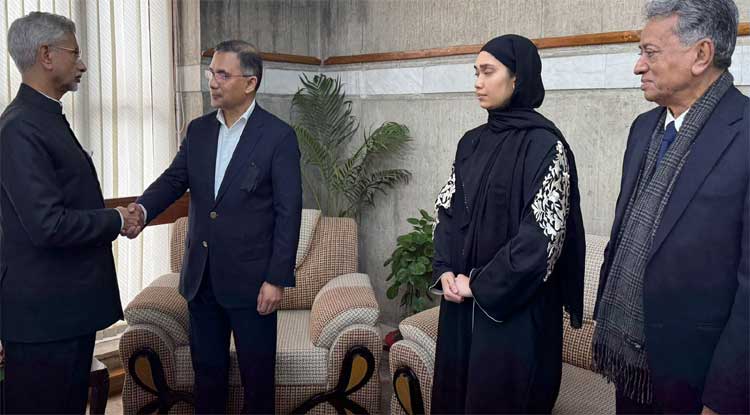
External Affairs Minister S. Jaishankar represented India at the funeral of former Bangladesh prime minister Khaleda Zia in Dhaka on Wednesday and conveyed New Delhi’s condolences to her son and political heir, Tarique Rahman, saying her vision would continue to guide the development of India-Bangladesh ties.
Jaishankar’s brief visit, lasting around four hours, marked the first by an Indian minister since bilateral relations hit a historic low following the formation of an interim government led by Muhammad Yunus in August 2024. The visit was widely seen in diplomatic circles as part of India’s outreach to the leadership of the Bangladesh Nationalist Party (BNP), which is widely expected to emerge as the largest party in the general election scheduled for February 12.
Like other visiting regional leaders, Jaishankar met Tarique Rahman, the BNP’s acting chairman, at the Parliament complex. Rahman recently returned to Bangladesh after spending 17 years in self-imposed exile in the United Kingdom. During the meeting, Jaishankar handed over a personal letter from Prime Minister Narendra Modi to Rahman.
“Conveyed deepest condolences on behalf of the Government and people of India. Expressed confidence that Begum Khaleda Zia’s vision and values will guide the development of our partnership,” Jaishankar said in a social media post.
Bangladesh’s High Commissioner to India, Riaz Hamidullah, who was present at the meeting, said Jaishankar recognised Khaleda Zia’s contribution to democracy and expressed optimism about strengthening bilateral ties following Bangladesh’s democratic transition through the upcoming election. He added that both sides looked forward to scripting a new chapter in India-Bangladesh relations, driven by shared interests, pragmatism and mutual interdependence.
Bangladesh’s National Security Adviser Khalilur Rahman, de facto law minister Asif Nazrul, Indian High Commissioner Pranay Verma and senior BNP leaders were also present during the meeting. Rahman has been leading the party from abroad since his mother’s health deteriorated several years ago.
There was no official readout from the Indian side on the discussions. Unlike several other regional leaders, Jaishankar did not meet interim chief adviser Muhammad Yunus during the visit.
At the Parliament complex, Jaishankar briefly exchanged pleasantries with Pakistan National Assembly Speaker Ayaz Sadiq, according to people familiar with the matter. There were no formal discussions during the interaction, which marked the first contact between senior Indian and Pakistani leaders since the two countries fought a four-day conflict in May.
India had carried out strikes on terrorist infrastructure in Pakistan on May 7 in retaliation for the April Pahalgam terror attack, triggering a brief but intense military confrontation that ended on May 10 after both sides agreed to halt hostilities.
Jaishankar also interacted with Bangladesh’s de facto foreign minister Touhid Hossain, Sri Lankan foreign minister Vijitha Herath, Nepal’s foreign minister Bala Nanda Sharma, Bhutan’s foreign minister D.N. Dhungyel and Maldivian minister Ali Haidar Ahmed.
Millions of people gathered in Dhaka for Khaleda Zia’s funeral prayers. A three-time prime minister, she had been a central figure in Bangladesh’s politics for decades and a fierce rival of former premier Sheikh Hasina, whose Awami League government was ousted in August 2024 following weeks of student-led protests.
The prayers were held in front of the Parliament building, with mourners spilling onto surrounding roads. Yunus, members of the interim government, and senior civilian and military officials attended the ceremony. Khaleda Zia was later buried with state honours beside the grave of her husband, former military ruler Ziaur Rahman.
Comments are closed.