
Kashmir’s Lifeline Under Threat: How Climate Change Is Drying Fields, Shrinking Rivers, and Breaking Farmers’ Lives

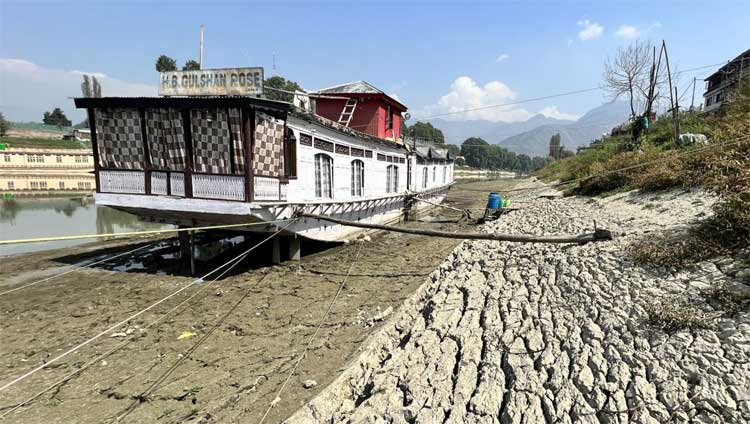
Kashmir has long been known for its lush green valleys, snow-fed rivers and orchards laden with apples, cherries and walnuts. Today, however, the very foundations of the region’s rural economy—agriculture and water—are under growing threat from climate change. Farmers across the Valley say shrinking glaciers, erratic rainfall and rising temperatures are pushing centuries-old farming systems toward collapse.
Agriculture employs more than 70% of Kashmir’s population and contributes nearly 15% to the local economy. But for many families, it is no longer a dependable source of livelihood. Farmers who have cultivated the same land for generations say climate change is no longer a distant concept but a daily reality marked by crop failures, water scarcity and mounting debt.
In Pulwama, apple grower Ghulam Nabi, who has tended orchards for over 30 years, says winters have become shorter and increasingly unpredictable. “The trees bloom early now,” he said, “but late frosts destroy the flowers.” As a result, apple yields in many areas have fallen by 40–50%. Apple cultivation accounts for over 75% of India’s apple production, making the crisis in Kashmir a national concern.
Saffron growers in Pampore are facing an even sharper decline. Once earning six to seven lakh rupees per acre, farmers now struggle to harvest even half their earlier yields. Warmer winters and erratic rainfall have disrupted the delicate flowering cycle of saffron, a labour-intensive crop deeply tied to the region’s cultural identity. Production, which stood at over eight metric tonnes in the early 2010s, has dropped to nearly a third of that, with families reporting losses of 60–70%.
Farming Precision Disrupted
Climate change is dismantling the finely balanced systems on which Kashmir’s agriculture depends. Rice paddies, spread across nearly 130,000 hectares, rely heavily on glacial rivers and snowmelt. Erratic rainfall and early snowmelt have reduced irrigation during critical growth periods. In villages such as Haritar and Lelhar, irrigation canals that once ensured steady water supply now run dry.
Many farmers are forced to pump water from deeper wells, driving up costs and energy use, while others leave fields fallow. Vegetable growers report yield declines of up to 35% in crops such as potatoes, cauliflower and tomatoes due to heat stress and water shortages.
The Human Cost of a Changing Climate
The impact goes far beyond crop statistics. Rising temperatures—averaging an increase of 0.6°C per decade over the last 30 years—have disrupted growing seasons. Farmers report heat waves in May and June scorching wheat and mustard crops, while delayed monsoon rains leave rice paddies parched.
For apple growers, the decline in chilling hours has been devastating. Average chilling hours have dropped from around 1,500 two decades ago to below 1,000 today, insufficient for optimal fruit development. To cope, farmers are investing in sprinklers and cooling systems, often taking loans they struggle to repay. Smallholders with less than two acres of land are particularly vulnerable, with many families slipping into debt or considering migration.
Extreme weather events have become routine. Late frosts in spring, hailstorms during peak fruiting season, and unseasonal rains that wash away fertile topsoil are now common. Farmers say these are no longer rare anomalies but a “new normal” that has broken the agricultural rhythm of the Valley.
Water Resources Under Siege
Water scarcity lies at the heart of Kashmir’s crisis. Glaciers such as Kolahoi, which feed major rivers, have retreated by nearly 900 metres over the past 50 years, sharply reducing summer flows. Springs that once supplied water year-round are drying up; nearly one in four major springs in farming villages has shown significant decline.
In districts like Pulwama and Shopian, lift irrigation systems now operate at less than half their capacity. Farmers increasingly depend on motor pumps, raising irrigation costs by 40–50%. For many smallholders, these measures are unaffordable, forcing them to abandon cultivation.
The impact extends beyond agriculture. Reduced river flows have affected hydropower generation, disrupting electricity supply in rural areas. Wetlands and groundwater recharge zones are shrinking, threatening long-term water security. When rain does arrive, it often comes in intense bursts, causing floods instead of replenishing groundwater.
A Question of Justice and Survival
Experts warn that Kashmir’s water and agriculture crisis is also a matter of climate justice. The region contributes minimally to global greenhouse gas emissions yet bears a disproportionate burden of climate impacts. Farmers and labourers who once lived in close harmony with nature are now among the first victims of global environmental change.
Addressing the crisis will require more than short-term fixes. Specialists stress the need for integrated watershed management, conservation of glaciers and springs, climate-resilient crops, efficient irrigation methods and community-based early warning systems. Policies, they say, must focus on smallholders and women farmers, ensuring access to resources, training and financial support.
Kashmir’s experience serves as a warning for other mountainous, glacier-fed regions. Without timely adaptation, climate stress could trigger food insecurity, economic shocks and migration far beyond the Valley.
As crops fail and rivers shrink, Kashmir’s agriculture stands at a critical crossroads. What is at stake is not only food production, but the cultural, social and economic identity of a region whose life has always been tied to its land and water. Climate change in Kashmir, farmers say, is no longer an environmental issue alone—it is a human crisis demanding urgent action.
Comments are closed.