
‘Kabul is India’s Proxy’: Pakistan’s Khawaja Asif Urges Afghans to Return Home Amid Rising Tensions

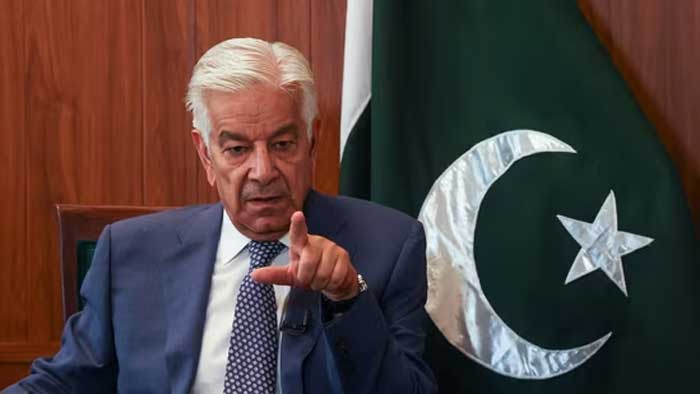
Pakistan’s Defence Minister Khawaja Asif on Friday issued a stern warning to Afghanistan, stating that Islamabad could no longer maintain relations with Kabul as it had in the past and threatening to exact a “heavy price” from any source of terrorism targeting Pakistan. His comments came as the initial 48-hour ceasefire between the two countries ended, though media reports suggested it was extended as delegations prepared to meet in Doha, Qatar, to discuss a resolution.
“Pakistan can no longer afford to maintain relations with Kabul as it did in the past,” Asif said in a social media post. He added, “All Afghans residing on Pakistani soil must return to their homeland; they now have their own government in Kabul… Our land and resources belong to 250 million Pakistanis. Self-respecting nations do not thrive on foreign land and resources.”
Asif claimed that despite Pakistan’s repeated diplomatic efforts over the past five years—including issuing 836 protest notes and 13 demarches—Kabul had shown little positive response. “There will no longer be protest notes or appeals for peace; no delegations will go to Kabul. Wherever the source of terrorism lies, it will have to pay a heavy price,” he warned.
He also accused Afghanistan of acting as a “proxy of India,” alleging collaboration with New Delhi and the banned Tehreek-i-Taliban Pakistan (TTP), though no evidence was provided. The minister reiterated Pakistan’s readiness to defend itself against further aggression, citing recent attacks allegedly staged from Afghan soil, including one in Khyber Pakhtunkhwa’s Orakzai district that killed 11 military personnel.
The tensions coincided with Afghanistan’s decision to withdraw from the upcoming Tri-Nation T20I series with Pakistan, following the deaths of three Afghan cricketers in airstrikes it described as a “cowardly attack carried out by the Pakistani regime.” The series, which also involved Sri Lanka, was scheduled to take place in Rawalpindi and Lahore from November 17–29.
The Afghanistan Cricket Board (ACB) expressed deep grief over the deaths of Kabeer, Sibghatullah, and Haroon, who were killed along with five others from Urgun District in Paktika Province after returning from a friendly match in Sharana. Seven others were injured.
“The Afghanistan Cricket Board expresses its deepest sorrow and grief over the tragic martyrdom of the brave cricketers… targeted in a cowardly attack carried out by the Pakistani regime,” the ACB said in a statement. “In response to this tragic incident and as a gesture of respect to the victims, the ACB has decided to withdraw from participating in the upcoming Tri-Nation T20I Series.”
Pakistan reportedly carried out airstrikes in Argun and Barmal districts of Paktika, further straining the fragile ceasefire. Afghan star spinner Rashid Khan condemned the strikes, calling them “absolutely immoral and barbaric” and a “grave violation of human rights.” He praised the ACB’s decision to withdraw from the series, emphasizing that national dignity must take precedence.
This escalation highlights the growing friction along the Pakistan-Afghanistan border, with repeated ceasefire violations, cross-border attacks, and retaliatory measures further destabilizing bilateral relations.
Comments are closed.