
Judge Orders Federal Agents to Limit Tear Gas at Portland ICE Protests

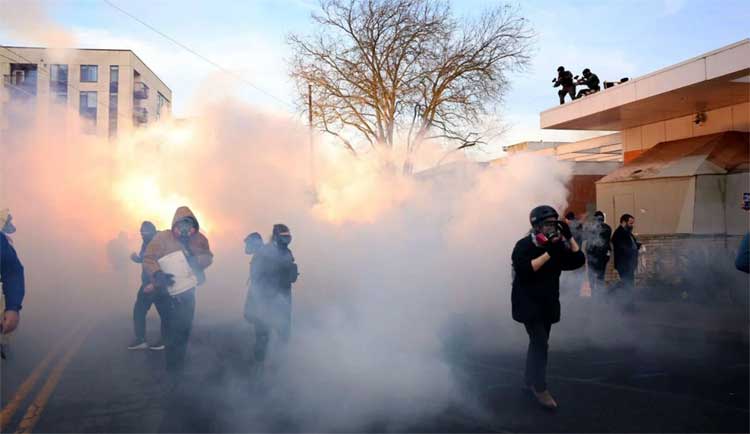
A federal judge in Oregon on Tuesday temporarily barred federal officers from using tear gas and certain crowd-control munitions at protests near the US Immigration and Customs Enforcement (ICE) building in Portland, following incidents in which agents deployed chemical agents against demonstrators, including young children.
US District Judge Michael Simon ordered officers not to use chemical or projectile munitions against individuals who pose no imminent threat of physical harm, or who are merely trespassing or refusing to disperse. He also prohibited officers from targeting the head, neck, or torso unless the use of deadly force is legally justified.
The temporary restraining order, which will remain in effect for 14 days, comes amid growing national debate over policing tactics at protests.
“The nation is now at a crossroads,” Simon wrote. “In a well-functioning constitutional democratic republic, free speech, courageous newsgathering, and nonviolent protest are permitted, respected, and even celebrated.”
The ruling follows a lawsuit filed by the American Civil Liberties Union of Oregon on behalf of protesters and freelance journalists who were affected by crowd-control measures at demonstrations near the ICE facility.
The lawsuit names the Department of Homeland Security, its Secretary Kristi Noem, and President Donald Trump as defendants. It argues that the use of chemical munitions and excessive force amounts to retaliation against protesters and violates their First Amendment rights.
In response, the Department of Homeland Security said its officers had followed proper training and used the minimum force necessary to protect people and property.
“DHS is taking appropriate and constitutional measures to uphold the rule of law and protect our officers and the public from dangerous rioters,” spokesperson Tricia McLaughlin said.
Similar legal challenges have emerged across the United States as protests against immigration enforcement intensify. In recent months, federal courts have issued and, in some cases, suspended rulings limiting the use of tear gas and pepper spray in cities such as Minneapolis and Chicago.
The Oregon complaint details several alleged incidents of excessive force, involving elderly protesters, costumed demonstrators, and journalists. Among them is 83-year-old Vietnam War veteran Richard Eckman and his wife Laurie, 84, who were injured during a peaceful march in October. Laurie Eckman was struck in the head by a pepper ball and treated for a concussion, according to court filings.
Another plaintiff, Jack Dickinson, known for wearing a chicken costume at protests, said he was repeatedly targeted despite posing no threat. Two freelance journalists, Hugo Rios and Mason Lake, also reported being struck with pepper balls and exposed to tear gas while clearly identified as members of the press.
The lawsuit seeks an injunction to prevent federal officers from using force against peaceful demonstrators and journalists.
Separately, residents of an affordable housing complex near the ICE building have filed a similar lawsuit, citing repeated exposure to chemical agents.
Local officials have criticised the federal response. Portland Mayor Keith Wilson called for ICE to leave the city, describing recent protests as peaceful and non-threatening.
“To those who continue to work for ICE: Resign. To those who control this facility: Leave,” Wilson said in a statement.
The Portland protest is part of a broader wave of demonstrations nationwide against the administration’s immigration crackdown, including in cities such as Minneapolis, where recent enforcement actions have sparked widespread outrage.
Comments are closed.