
Jaishankar Raises Gaza, Maritime Security at India-Arab Meet; Warns Against Terrorism

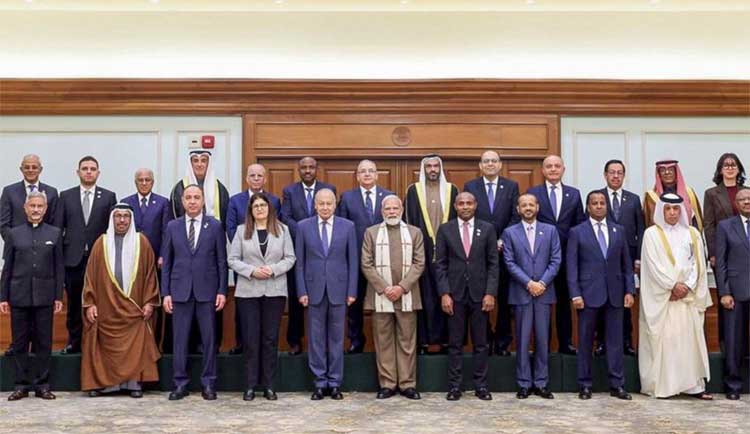
Advancing the Gaza peace plan, addressing conflicts in Sudan and Yemen, and countering the shared threat of terrorism dominated discussions at the India–Arab foreign ministers’ meeting held on Saturday, with New Delhi calling for coordinated efforts to strengthen security and stability across West Asia.
The meeting, attended by foreign ministers and senior officials from 19 Arab League member states—including Saudi Arabia, Egypt, Kuwait and Qatar—was only the second such engagement since the inaugural meeting in 2016. It took place amid heightened regional tensions and significant geopolitical churn.
Delegates also met Prime Minister Narendra Modi, who described the Arab world as part of India’s “extended neighbourhood,” bound by civilisational ties and a shared commitment to peace and prosperity. In a social media post, Modi said enhanced cooperation in technology, energy, trade and innovation could unlock new opportunities and elevate the partnership to “new heights.”
Focus on Gaza and Regional Stability
External affairs minister S. Jaishankar said that taking forward a comprehensive plan to end the Gaza conflict, based on UN Security Council Resolution 2803, was a widely shared priority.
“Various countries have made policy declarations on the peace plan, individually or collectively,” Jaishankar said, stressing the need to translate these commitments into action.
He noted that rapid changes in global politics, economics, technology and demography were reshaping the international order, with the impact most evident in West Asia.
“Nowhere is this more apparent than in the Middle East, where the landscape has undergone a dramatic change in the last year,” he said, adding that developments in the region directly affect India due to its geographical proximity and deep ties.
Other Regional Conflicts
While Gaza remains at the centre of global attention, Jaishankar highlighted other pressing challenges, including the conflict in Sudan, which he said is “exacting a deadly toll on its society,” and the war in Yemen, which poses risks to maritime navigation.
He also referred to concerns in Lebanon, where India contributes troops to the UN Interim Force in Lebanon (UNIFIL), the need to advance national dialogue in Libya, and the importance of developments in Syria for the region’s long-term stability.
“The shared interest of India and Arab nations lies in strengthening the forces of peace, stability and prosperity,” he said.
Terrorism a Common Threat
Describing terrorism as a shared challenge for both regions, Jaishankar called for zero tolerance toward terror and stressed the importance of stronger global cooperation.
“Cross-border terrorism is particularly unacceptable, as it violates the basic principles of international relations and diplomacy,” he said, adding that societies targeted by terrorism have the right to defend themselves.
Expanding Cooperation
Jaishankar underlined India’s strong partnerships with all Arab League members, noting that West Asia hosts nearly 10 million Indians, mainly in Saudi Arabia and the United Arab Emirates.
The region is critical for India’s energy security, with Iraq and Saudi Arabia among its top three oil suppliers, alongside Russia. Jaishankar also highlighted close cooperation on food and health security.
The meeting discussed a roadmap for cooperation during 2026–28, covering traditional sectors such as energy, agriculture, tourism and human resource development, as well as emerging areas including digital technology, space, startups and innovation.
“We will also explore cooperation in counter-terrorism and parliamentary exchanges,” Jaishankar said, adding that India is keen to share its expertise in people-centric technological applications.
Trade and Investment Push
Ahead of the meeting, India and Arab partners launched the India–Arab Chamber of Commerce, Industry and Agriculture on Friday, aimed at deepening trade and investment ties between the two sides.
Comments are closed.