
Italy Greenlights €13.5 Billion Messina Bridge Project, Set to Become World’s Longest Suspension Bridge

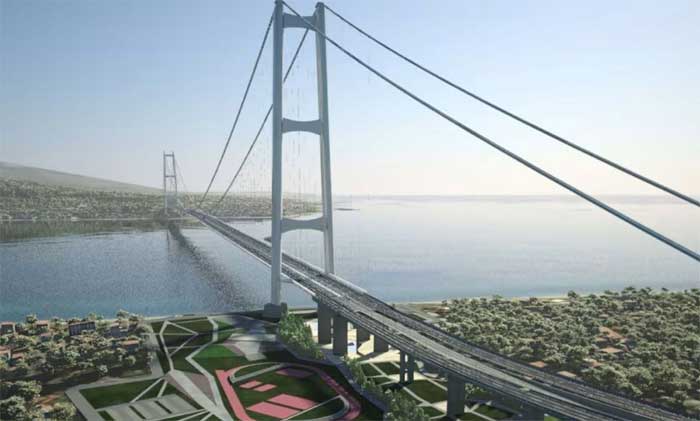
Italy on Wednesday approved plans to build the world’s largest suspension bridge, linking the mainland to Sicily across the Strait of Messina—a €13.5 billion ($15.5 billion) megaproject long delayed by concerns over its seismic risks, environmental impact, and potential mafia infiltration.
“This will be the biggest infrastructure project in the West,” declared Transport Minister Matteo Salvini at a press conference in Rome, following the interministerial committee’s approval. He also highlighted the bridge as a future “engineering symbol of global significance,” echoing remarks by Prime Minister Giorgia Meloni.
The project, dormant for decades since first being proposed in 1969, reached its most advanced stage yet after being revived by Meloni’s government in 2023. Construction could begin as early as 2026, following audit approval this fall, with completion targeted between 2032 and 2033.
World Record-Breaking Design
Spanning nearly 3.7 kilometers (2.2 miles) with a suspended central span of 3.3 kilometers (over 2 miles), the bridge would eclipse Turkey’s Canakkale Bridge by over 1,200 meters to become the longest suspension bridge in the world.
Designed to accommodate three lanes of traffic in each direction alongside a double-track railway, the structure is expected to carry up to 6,000 cars per hour and 200 trains daily. It would slash crossing times from 100 minutes by ferry to just 10 minutes by car and save trains up to 2.5 hours in travel time.
Classified as Defense Infrastructure
Salvini suggested that the bridge could count toward Italy’s NATO defense spending target. Officials are exploring a “dual-use” classification, citing the bridge’s strategic value for moving troops and equipment to southern Europe. However, critics—including over 600 academics—warned that such a classification would require further safety assessments and could turn the bridge into a military target.
Environmental and Mafia Concerns
Environmental groups have filed complaints with the EU, citing harm to migratory bird paths and a lack of proof that the project’s public benefit outweighs the ecological cost.
Meanwhile, anti-mafia oversight remains a central concern. Italy’s president insisted that the project comply with existing anti-mafia regulations rather than rely on a special framework. Salvini pledged tight safeguards and likened the control protocols to those used during Expo 2015 and the upcoming 2026 Milan-Cortina Winter Olympics.
Engineering Amid Earthquake Risk
Built in a seismically active region—near the site of the deadly 1908 earthquake that devastated Messina—the bridge has been designed with seismic resilience in mind. Construction firm Webuild, which leads the project consortium, cited similar suspension bridges in Japan, Turkey, and California as precedent.
Webuild CEO Pietro Salini called the bridge “transformative for the entire country,” noting that it could generate 120,000 jobs annually and stimulate investment in southern Italy’s lagging economy.
Once completed, the Strait of Messina Bridge would not only reshape Italy’s geography but also stand as a landmark of global engineering ambition.
Comments are closed.