
Israel’s Settler Movement Takes Victory Lap as a Sparse Outpost Becomes a Settlement Within a Month

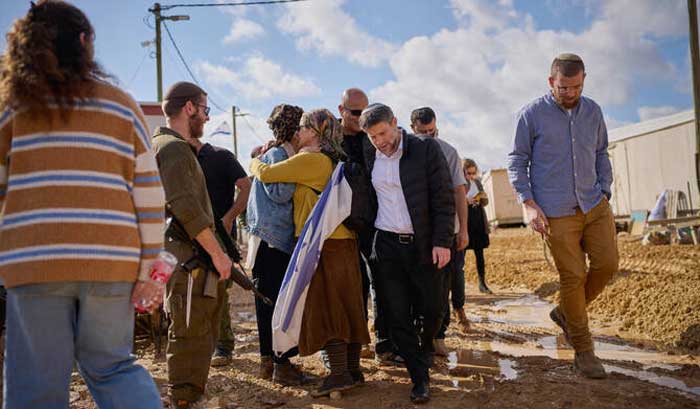
Celebratory music blared from loudspeakers, mingling with the sounds of construction and nearly drowning out the call to prayer drifting from a mosque in the Palestinian town across the West Bank valley. On the hilltop above Beit Sahour, Orthodox Jewish women in colorful head coverings shared platters of vegetables, babies perched on their hips, as Israeli soldiers formed a protective ring around the gathering.
The scene on Monday marked the culmination of a long campaign by Israeli settlers to transform the site into a permanent settlement. After years of resistance to plans for a Palestinian children’s hospital on the land, settlers say their persistence has paid off.
The newly inaugurated settlement, called Yatziv — Hebrew for “stable” — has moved with remarkable speed from an unauthorized outpost of a few mobile homes to a fully recognized settlement. What took settlers two decades of lobbying and activism was finalized in just one month.
“We are standing stable here in Israel,” Finance Minister Bezalel Smotrich, a longtime settler leader, told the Associated Press at the inauguration. “We’re going to be here forever. We will never establish a Palestinian state here.”
Smotrich’s Settlement Push
With Smotrich overseeing settlement policy for the past three years and holding a senior role in Israel’s government, settlers say they feel newly empowered. His tenure has coincided with an aggressive expansion drive across the occupied West Bank, aimed at foreclosing the possibility of a future Palestinian state.
Most of the international community considers Israeli settlements illegal under international law. Palestinians say their rapid expansion fragments the territory and makes a viable, independent state increasingly impossible. The West Bank, captured by Israel in 1967, is central to Palestinian statehood aspirations.
Political Tailwinds for Settlers
Settlers had long targeted the hilltop overlooking Beit Sahour, citing its strategic location along a chain of settlements encircling Jerusalem and its perceived historical significance to Jews. They erected prefabricated homes there in November, shortly after a Palestinian attacker fatally stabbed an Israeli at a nearby junction.
That attack helped provide political justification for the outpost, said Yaron Rosenthal, head of the local settlement council. He pointed to Israel’s far-right government, the return of Donald Trump to the U.S. presidency last year, and the November violence as factors that created an opening.
“We understood that there was an opportunity,” Rosenthal said. “But we didn’t know it would happen so quickly. Now there is the right political constellation for this to happen.”
Smotrich formally approved the outpost — along with 18 others — on Dec. 21, capping what settler activist Nadia Matar described as a 20-year struggle.
“Shdema was nearly lost to us,” Matar said, using the name of an Israeli military base once located at the site. “What prevented that outcome was perseverance.”
From Hospital Plan to Settlement
In 2006, settlers were outraged to learn that Israel was discussing plans with the United States to build a Palestinian children’s hospital on the land. At the same time, the U.S. Agency for International Development was funding a “peace park” at the foot of the hill.
The mayor of Beit Sahour urged the U.S. Consulate to press Israel to move forward with the hospital, while settlers staged weekly protests demanding the project be scrapped, according to diplomatic cables later published by WikiLeaks.
At the time, U.S. consulate staff noted settlers had no clear religious, legal, or security claim to the land. “They just don’t want the Palestinians to have it — and for a hospital no less,” wrote consulate official Matt Fuller in an email shared with AP.
The hospital was never built. After Benjamin Netanyahu returned to power in 2009, the land was converted into a military base — a turning point, former Prime Minister Ehud Olmert said.
“Once it is a military installation, it is easier to change its status into a new outpost, a new settlement,” Olmert said, accusing Netanyahu of abandoning cooperation with Palestinians.
Palestinian Fears Deepen
For Palestinians in Beit Sahour, the legalization of Yatziv reinforces a sense of dispossession. Settler violence rose 27 percent in 2025, according to Israel’s military, further entrenching fear across the West Bank.
“These lands have been owned by families from Beit Sahour since ancient times,” said the town’s mayor, Elias Isseid. He warned that Yatziv is part of a growing ring of settlements connected by Israeli-only roads leading to Jerusalem.
The new settlement, he said, “poses a great danger to our children and our families.”
A newly paved bypass road, marked by a bright yellow gate, now winds up to Yatziv. Below it, the once-envisioned peace park lies empty — a quiet reminder of plans that never materialized.
Comments are closed.