
India’s Shubhanshu Shukla to Fly on Axiom-4 Mission to ISS as Launch Set for June 25

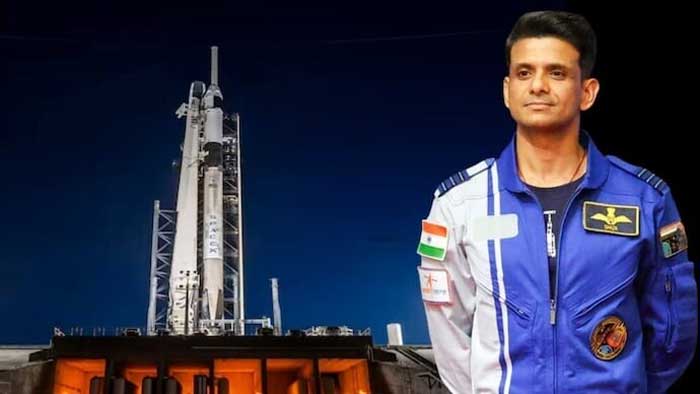
After several delays, the much-awaited Axiom Mission 4 (Ax-4) to the International Space Station (ISS) — featuring Indian astronaut Shubhanshu Shukla — is now scheduled to lift off on Wednesday, June 25 at 2:31 am EDT (around 12:00 noon IST) from Launch Complex 39A at NASA’s Kennedy Space Center in Florida.
The four-person crew will travel aboard a SpaceX Falcon 9 rocket, with SpaceX confirming via a post on X (formerly Twitter) that “all systems are looking good” and weather conditions are 90% favorable for liftoff.
What is the Axiom-4 Mission?
Ax-4 is a private astronaut mission organized by Axiom Space in collaboration with NASA and SpaceX. It marks a historic return to government-sponsored human spaceflight for India, Poland, and Hungary, all of whom are sending astronauts to the ISS for the first time in over 40 years. This will also be the first time all three nations fly a crewed mission to the ISS.
The mission is packed with scientific objectives — it will carry out around 60 experiments and activities representing 31 countries, including India, the US, Poland, Hungary, UAE, Saudi Arabia, Nigeria, Brazil, and several European nations.
Meet the Crew
-
Shubhanshu Shukla (India) – Serving as the pilot, Shukla is an astronaut with the Indian Space Research Organisation (ISRO), and this mission marks a significant milestone in India’s human spaceflight program.
-
Peggy Whitson (USA) – A veteran former NASA astronaut and the director of human spaceflight at Axiom Space, Whitson will command the mission. She has previously completed three missions to space and holds multiple NASA records.
-
Sławosz Uznański-Wiśniewski (Poland) – An ESA project astronaut, Uznański-Wiśniewski will serve as a mission specialist, representing Poland in its second-ever human spaceflight.
-
Tibor Kapu (Hungary) – Also a mission specialist, Kapu’s participation marks Hungary’s return to crewed spaceflight after decades.
If successful, the mission will not only advance space science and international cooperation but also mark a symbolic step forward in the democratization of space access through public-private partnerships.
Comments are closed.