
India’s Science Surge: Dr. Jitendra Singh Highlights 11 Years of Unprecedented Growth in Technology and Innovation

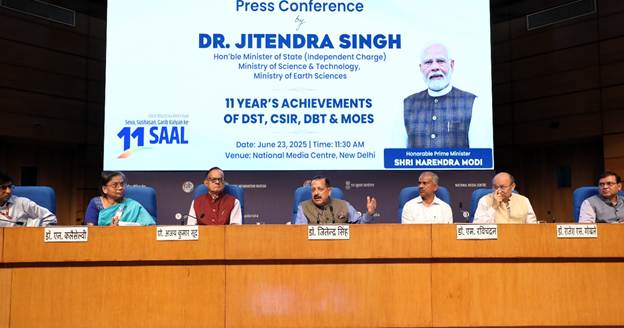
India’s ascent from the periphery to the center of the global scientific and technological ecosystem has been nothing short of transformative. Union Minister Dr. Jitendra Singh, addressing a joint media interaction of all Science Ministries at the National Media Centre, declared that the past 11 years have turned technology into the engine of India’s growth story, propelled by science-led governance and innovation-friendly reforms under the leadership of Prime Minister Narendra Modi.
India Shapes Global Scientific Discourse
“In the changed scenario over the last one decade, India is not just participating but is shaping global scientific discourse,” said Dr. Singh. Once a follower, India is now setting benchmarks in fields ranging from space science and biotechnology to climate resilience and digital governance.
Dr. Singh emphasized how reforms such as the unlocking of space and nuclear sectors, ease of doing science, and trust in scientific institutions have led to exponential progress, not just in research labs but across agriculture, health, defense, and rural empowerment.
Biotech Takes Off: From COVID Vaccines to Space Biology
Dr. Jitendra Singh highlighted major strides in the biotechnology sector, which he termed “India’s next economic powerhouse,” guided by the BioE3 Policy—Biotechnology for Economy, Environment, and Employment.
Among the landmark achievements:
-
India’s first DNA-based COVID-19 vaccine, an indigenous innovation during the pandemic.
-
Haemophilia therapy trials, showcasing India’s emerging strength in gene therapy and rare disease treatment.
-
The development of Kisan BiokkAvch, an anti-insecticide suit aimed at protecting India’s farmers from chemical exposure.
-
And notably, India-developed biotech kits will soon be used in outer space by astronaut Shubhanshu Shukla during the upcoming Axiom 4 Mission, marking a major leap in India’s space bioscience capabilities.
CSIR and Agri-Tech Innovation
Lauding the Council of Scientific & Industrial Research (CSIR), Dr. Singh spotlighted its role in promoting aroma-based agri-startups such as the Purple Revolution, which has seen lavender cultivation expand across Himalayan states, providing both economic uplift and ecological balance.
CSIR’s 37 labs are now aligned with industry demand, offering homegrown solutions in chemicals, materials, and sustainable technologies.
Digital Empowerment Through Science
From geo-mapping land titles to AI-powered farming insights, science is revolutionizing governance. Under the Department of Science and Technology (DST):
-
Drones and satellites have mapped soil quality and ownership records under the Swamitva and Soil Health Card Missions, empowering rural landowners with data-driven decisions.
-
Real-time disaster warnings have been deployed in urban centers like Delhi-NCR, thanks to radar expansions by the Ministry of Earth Sciences.
-
The government now leverages geo-tagged technology for land record modernization, aiding transparency and reducing bureaucratic dependency.
“Our farmer is now the master of his own destiny, thanks to science,” said Dr. Singh.
Deep Sea to Deep Space: India’s Scientific Range Expands
India’s foray into frontier science is not limited to land-based innovations. Dr. Singh confirmed that the ambitious Samudrayaan Mission is on track, with Matsya 6000, the deep-sea submersible, undergoing final safety trials. Sea trials are expected to begin in 2026, making India among the few countries with indigenous deep-sea exploration capability.
Meanwhile, space science continues to gain momentum with India’s increasing contributions to international space missions, public-private collaborations, and indigenous human spaceflight prep.
Institutional Trust and Scientific Freedom
A recurring theme in Dr. Singh’s address was the “freedom to innovate” that Indian scientists now enjoy under the current leadership. “Such trust in science from the highest level of leadership is rare,” he said. “It has transformed India into a global hub for innovation, not imitation.”
Biotech Economy Surges to $165.7 Billion
According to Dr. Rajesh Gokhale, Secretary of the Department of Biotechnology, the biotech sector has:
-
Developed seven indigenous vaccines
-
Filed over 1,750 patents
-
Sequenced more than 300,000 COVID-19 genomes
-
Contributed to raising India’s bioeconomy to $165.7 billion
India as a Scientific Guide, Not a Follower
Concluding the session, Dr. Jitendra Singh noted that India is no longer borrowing best practices—it is leading with scalable, frugal, and people-first solutions. Echoing this sentiment, Principal Scientific Advisor Prof. Ajay Kumar Sood said, “Science has truly come to the center stage in India’s development journey.”
From space to sea, lab to land, and from pandemic response to rural transformation, India’s scientific journey over the last 11 years illustrates a conscious shift from reactive policy to proactive innovation. With sustained government support, robust institutional collaboration, and a visionary national strategy, India is not just building its future—it is helping to define the world’s scientific future.
Comments are closed.