
India’s Move to Suspend Indus Waters Treaty Sends Shockwaves Through Pakistan

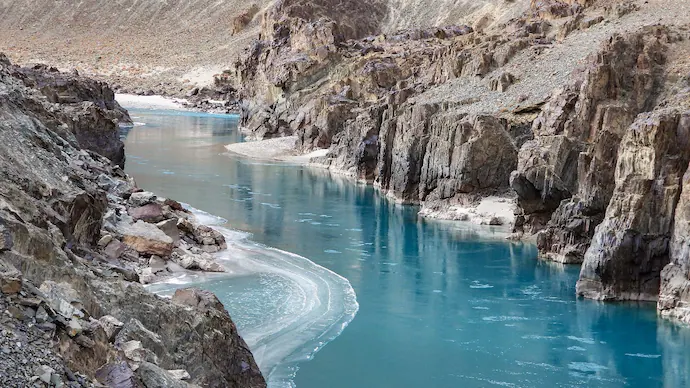
In a world where water is fast replacing oil as the most contested strategic resource, the fragile peace sustained by the Indus Waters Treaty (IWT) is now under threat. Union Home Minister Amit Shah’s recent declaration to suspend the treaty has jolted not only diplomatic corridors but also Pakistan’s internal stability, raising concerns of a regional humanitarian crisis.
Signed in 1960 with World Bank mediation, the IWT has for decades served as a rare example of cooperation between India and Pakistan, even during periods of war and political hostility. The treaty gives Pakistan control over the western rivers of the Indus basin—Indus, Jhelum, and Chenab—which account for nearly 80% of its water supply, particularly vital for its agriculture-heavy economy.
Amit Shah’s Statement: A Watershed Moment
During a high-level security briefing last week, Home Minister Amit Shah stated that India can no longer be expected to honor a treaty that benefits a nation “harboring hostility and terrorism.” The move to suspend the treaty, Shah emphasized, is rooted in national security, sovereignty, and resource rights.
While there has been no official abrogation of the treaty as of yet, Shah’s words are being interpreted as a clear signal of intent, with the potential to trigger drastic changes in water regulation and river usage.
Pakistan’s Vulnerability
For Pakistan, this declaration is more than a diplomatic rupture—it’s a direct hit to the core of its food security, irrigation networks, and power generation. The country’s Punjab province, considered the breadbasket of Pakistan, depends almost entirely on the waters of the Chenab and Jhelum rivers.
Experts warn that any disruption in water flow from India could:
-
Cripple Pakistan’s wheat and rice production,
-
Exacerbate ongoing power shortages due to hydroelectric dependency,
-
Lead to water rationing in urban centers,
-
Deepen social unrest in water-stressed regions like Sindh and Balochistan.
A senior Pakistani official, speaking anonymously, described the situation as “an existential crisis disguised as a diplomatic one.”
Geopolitical & Legal Implications
Under international law, particularly the Vienna Convention on the Law of Treaties, unilateral withdrawal from treaties is complex and controversial, especially when water-sharing agreements are involved. India, however, has been raising concerns for years about Pakistan’s alleged misuse of IWT provisions to stall development projects in Jammu & Kashmir.
In recent years, India has begun expediting construction of dams and hydroelectric projects on the western rivers—projects Pakistan contests at international forums, often with delays and legal resistance.
Shah’s remarks could open the door for India to renegotiate or reassert control over how water resources are utilized, especially in its own territory, without entirely breaching international norms.
Domestic and Global Reactions
The Indian government’s firm stance has been met with mixed reactions domestically. While strategic analysts and nationalist circles have hailed the decision as long overdue, some voices in the policy community have cautioned against provoking a humanitarian backlash or losing India’s moral high ground in global diplomacy.
Globally, the development has drawn close attention from the UN, the World Bank (a signatory to the IWT), and major powers like China and the US, all of whom have strategic interests in South Asia’s water stability.
The suspension of the Indus Waters Treaty, if formally carried out, could mark the beginning of a new era in India–Pakistan relations—one defined by strategic resource control rather than conventional diplomacy. With water becoming the new currency of power in a warming world, this development is not just a regional flashpoint, but potentially a case study in how environmental assets are redefined as tools of national leverage.
Comments are closed.