
India vs West Indies 2nd T20I: Naman Dhir’s Bowling Gives India Fresh Options Ahead Of 2028 T20 World Cup

India’s second T20I against the West Indies in Ranchi is about more than securing another victory. With the next T20 World Cup scheduled for 2028, India have valuable time to experiment with their bowling resources, identify promising all-rounders and build a stronger pool of players capable of handling the demands of international cricket.
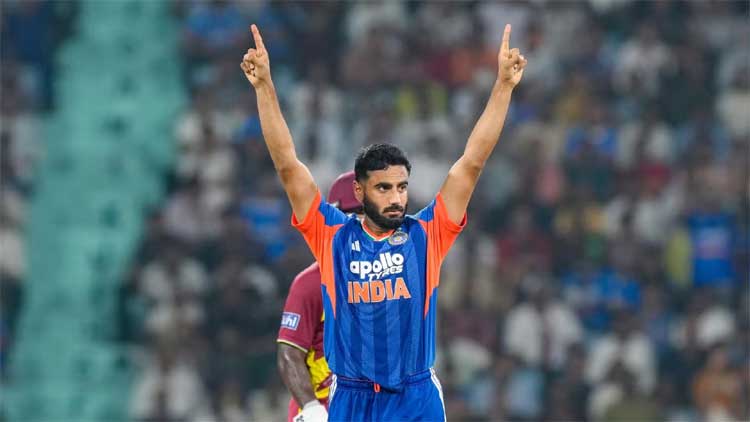
Naman Dhir’s impressive performance in Lucknow has given the team management another option to consider. Primarily known for his power-hitting, Dhir delivered with the ball as well, claiming 3/31 in a performance that highlighted his growing skills as an all-rounder.
His contribution has also underlined an important aspect of India’s preparations for future tournaments: developing additional bowling options rather than relying on the same group of frontline bowlers across formats and series.
Naman Dhir Impresses With Bowling Skills In Lucknow
Dhir was not expected to be the main talking point of India’s bowling attack, but his performance in Lucknow caught attention. On a surface that rewarded patience and variations, he used flight and changes of pace effectively instead of becoming defensive when batters attacked him.
India wicketkeeper-batter Ishan Kishan praised Dhir’s improvement, pointing to his confidence and willingness to flight the ball even after being hit for a six.
“I have seen him bowl in MI. That time he was more like a part-timer,” Kishan said after the match.
“But looking at his seam position, the way he was bowling today… you usually go defensive after being hit for six, but he was giving extra flight today. You can figure out that this man has worked on his skills.”
The performance suggested that Dhir’s bowling could become a useful asset for India as they assess their options for the coming years.
India Look To Strengthen Their Bowling Resources
India already have several established options in their bowling attack. Arshdeep Singh provides a left-arm pace option, Axar Patel offers control and variety, while Kuldeep Yadav brings wrist-spin capable of changing the course of the middle overs. Mayank Yadav, meanwhile, offers the prospect of express pace.
However, building a successful World Cup squad requires depth beyond the first-choice bowlers.
Jasprit Bumrah’s workload needs careful management, while Mohammed Siraj and Prasidh Krishna also have commitments and roles across formats. Axar and Kuldeep cannot be expected to shoulder the burden of every white-ball assignment throughout an increasingly demanding international calendar.
India therefore need alternatives who can step in when required and offer different combinations without significantly weakening the side.
The period leading up to the 2028 T20 World Cup provides an opportunity to test those options under match conditions and assess how they respond to pressure.
Why Dhir’s All-Round Ability Matters
Dhir has largely earned recognition for his batting, particularly his ability to strike the ball powerfully in the lower order. His performances for Mumbai Indians have highlighted his potential to accelerate the scoring rate during the final overs.
His bowling, however, has often received less attention. His three-wicket haul in Lucknow offered a reminder that he could contribute in both departments.
Dhir said his bowling development was not a sudden change and that he had been working consistently on the skill.
“Even if you haven’t seen me bowling, I am bowling the same amount that I have done here,” he said.
“It’s not like I am a batting allrounder or a bowling allrounder. Yes, my batting is a plus point, but at the same time, I am working as hard at bowling.”
His comments reflect the work required to become a more complete T20 player. For India, an all-rounder who can deliver useful overs while remaining capable of scoring quickly at the death could provide valuable flexibility.
Abhishek Sharma, Tilak Varma Among Batters Exploring Bowling
Dhir is not the only Indian batter developing his bowling. Abhishek Sharma has also offered India an additional option, while Tilak Varma has been seen bowling in domestic cricket, including the Duleep Trophy.
Such players can help India create more balanced combinations, particularly when specialist all-rounders are unavailable.
Washington Sundar’s withdrawal from the T20I series has created an opportunity to assess alternatives. Dhir has stepped into a role that could allow India to field a lower-order batter who can also contribute as a fifth or sixth bowling option.
If a player in that role can consistently deliver two or three effective overs without compromising the team’s batting strength, the captain gains greater flexibility in managing the innings.
That flexibility could prove especially valuable in a major tournament, where conditions, opposition match-ups and injuries can force teams to adapt quickly.
Prince Yadav And Nitish Kumar Reddy Also In Contention
Dhir’s performance has added to the list of players India could assess as they prepare for future T20 assignments.
Prince Yadav is another name worth monitoring, having already been part of the wider selection conversation. Nitish Kumar Reddy also offers all-round abilities that could help India balance their playing XI.
The objective is not necessarily to find another specialist bowler. Instead, India can benefit from identifying players who offer multiple skills and allow the team management to make tactical adjustments depending on conditions and opposition.
With established performers already available, India have the opportunity to explore alternatives without placing excessive pressure on inexperienced players to deliver immediately in a major tournament.
Ranchi Offers Another Opportunity To Experiment
India’s second T20I against the West Indies in Ranchi presents another chance to evaluate their resources and determine whether Dhir’s performance in Lucknow can be built upon.
The team management will be looking beyond the immediate result to assess the effectiveness of different combinations, the reliability of additional bowling options and the development of players who could contribute over the long term.
There is little value in identifying a promising option shortly before a World Cup if that player has not received enough opportunities to gain experience under pressure.
Dhir’s performance has given India an encouraging indication of what sustained development can produce. Prince Yadav, Nitish Kumar Reddy and other emerging options could also benefit from opportunities as India expand their pool of T20-ready players.
With the 2028 T20 World Cup still some distance away, the challenge is to turn promising performances into dependable options. For India, the Ranchi match and the wider series could be important steps towards building the depth and flexibility needed for another serious World Cup campaign.
Comments are closed, but trackbacks and pingbacks are open.