
India Urges Developed Nations to Fast-Track Net-Zero Goals, Boost Concessional Climate Finance at COP30

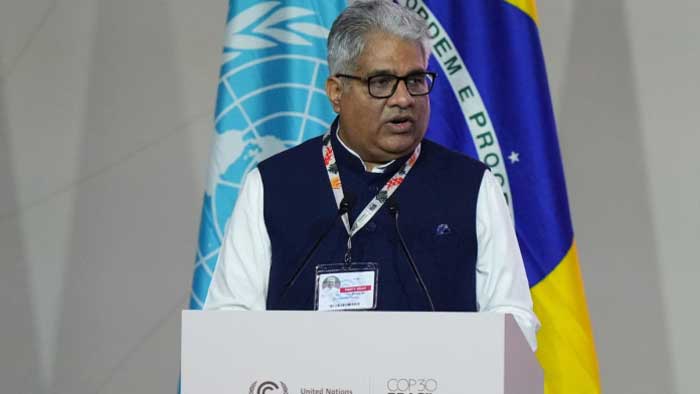
India on Monday pressed developed countries to advance their net-zero timelines, honour their Paris Agreement commitments, and scale up concessional climate finance for developing nations.
Delivering India’s national statement at the UNFCCC’s COP30 summit in Brazil, Union Environment Minister Bhupender Yadav underscored New Delhi’s climate leadership and confirmed that India will submit its updated nationally determined contributions (NDCs) by December.
India and Saudi Arabia remain the only G20 members yet to file updated NDCs for COP30. Yadav dismissed suggestions of delay, noting that the process requires multiple approvals, including cabinet clearance. “We will declare our revised NDCs till 2035 and also the first Biennial Transparency Report,” he said.
In his address, Yadav called on industrialised nations to “reach net zero far earlier than current target dates” and deliver “new, additional and concessional climate finance estimated in trillions of dollars,” as required under Article 9.1 of the Paris Agreement. He emphasised that climate finance must be “adequate, accessible, affordable and free from restrictive intellectual property barriers.”
The demand for concessional finance comes amid growing frustration among developing nations. A new report by Oxfam and the CARE Climate Justice Centre found that nearly two-thirds of climate finance is being extended as loans — a trend the organisations criticised as “crisis profiteering” that exacerbates debt and undermines climate action.
Several smaller nations, including Mauritius and Sierra Leone, echoed India’s concerns, stressing the unequal burden borne by countries that have contributed “almost nothing” to the climate crisis. Sierra Leone’s Environment Minister Jiwoh Emmanuel Abdulai called this imbalance “unjust and morally indefensible.”
Yadav highlighted India’s progress, noting a more than 36% reduction in emission intensity since 2005. He pointed to the International Solar Alliance, Global Biofuel Alliance, and the newly launched Nuclear Mission and Green Hydrogen Mission as examples of India’s growing global climate influence and its trajectory toward net zero by 2070.
He also praised community-led efforts, citing the planting of two billion saplings in 16 months as evidence of India’s grassroots commitment to climate action.
Calling for COP30 to be remembered as a “COP of implementation and delivery,” Yadav urged nations to strengthen collective resolve. “As we look ahead, let the coming decade be one of implementation, resilience, and shared responsibility — a decade that unites the world in the spirit of ‘one earth, one family, one future’,” he said.
Comments are closed.