
India Rejects China’s Claim on Dalai Lama Succession, Says Only He Can Decide His Reincarnation

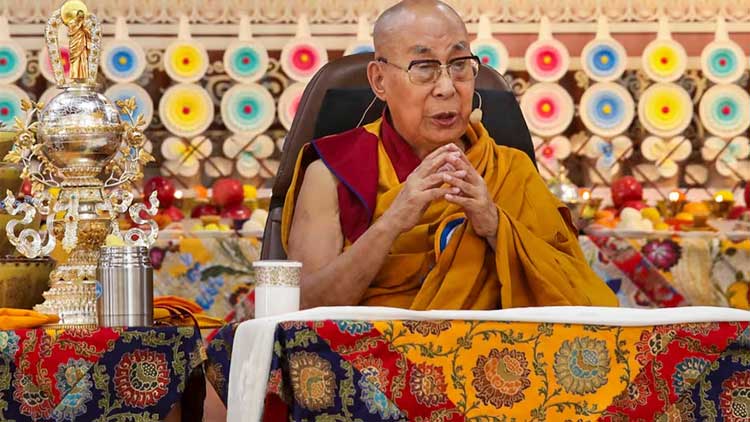
A day after Beijing insisted that the reincarnation of the Dalai Lama must receive its official approval, India firmly rejected the claim, asserting that only the Dalai Lama and the traditional Tibetan Buddhist institution have the authority to decide his successor.
Union Minister Kiren Rijiju, a practicing Buddhist and the government’s representative at the Dalai Lama’s upcoming 90th birthday celebration in Dharamshala on July 6, dismissed China’s assertion as baseless.
“The Dalai Lama is the most important and defining institution of Buddhism,” Rijiju told PTI. “Only he, along with the established traditions and conventions, can decide on the next incarnation. No one else has that right.”
Dalai Lama Reaffirms Sole Authority Over Succession
The comments follow a strong statement by the 14th Dalai Lama, Tenzin Gyatso, reaffirming that the Gaden Phodrang Trust, a non-profit body he established in 2015, will have exclusive authority to recognise his future reincarnation.
“I reiterate that the Gaden Phodrang Trust has sole authority to recognise the future reincarnation. No one else has any such authority to interfere in this matter,” he declared.
The Dalai Lama also confirmed that the centuries-old tradition of reincarnation will continue, but made it clear that China will play no role in the process.
China Responds with Fury
Beijing quickly condemned the Dalai Lama’s remarks. Chinese foreign ministry spokesperson Mao Ning insisted that the central government in Beijing must approve the reincarnation, in line with a process involving the drawing of lots from a “golden urn” — a method introduced during the Qing dynasty.
“The reincarnation of the Dalai Lama, the Panchen Lama, and other Tibetan Buddhist figures must be chosen by drawing lots from the golden urn and approved by the central government,” Mao said.
China has long considered the Dalai Lama a “separatist” for his advocacy of Tibetan autonomy and cultural preservation, despite the Nobel Peace laureate’s repeated calls for non-violence and dialogue.
The Bigger Picture
The 14th Dalai Lama, now nearing 90, fled Tibet in 1959 at the age of 23 following China’s takeover of the region. He has lived in exile in India ever since, continuing to serve as a spiritual leader for millions of Buddhists worldwide.
Back in 2011, he had announced that he would clarify whether the institution of the Dalai Lama would continue — a decision he pledged to make by his 90th birthday. With that day approaching, his recent statements are being seen as a clear assertion of spiritual autonomy in the face of political interference.
India’s support for the Dalai Lama’s authority over his succession underscores the deep religious and cultural respect he commands globally—and reflects growing tensions between New Delhi and Beijing over Tibet’s spiritual future.
Comments are closed.