
India, Australia seal uranium deal, deepen defence and Indo-Pacific ties during PM Modi’s visit

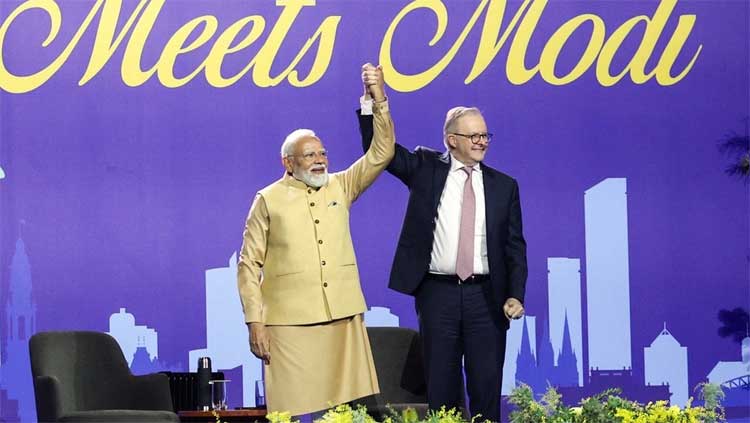
India and Australia on Thursday signed a landmark agreement for the long-term supply of Australian uranium to support India’s nuclear energy programme and unveiled a broad package of initiatives to strengthen cooperation in defence, maritime security, critical minerals, energy and advanced technologies.
Prime Minister Narendra Modi and his Australian counterpart Anthony Albanese announced the outcomes after bilateral talks in Melbourne during Modi’s three-nation Indo-Pacific tour, aimed at expanding economic and strategic partnerships amid China’s growing regional assertiveness and evolving global geopolitical challenges.
Uranium pact to boost India’s clean energy goals
The two leaders announced an administrative arrangement under the bilateral Nuclear Cooperation Agreement that will facilitate long-term Australian uranium exports for India’s civilian nuclear energy programme.
Calling the agreement a major step forward, Modi said it would provide fresh momentum to India’s clean energy ambitions.
“The important agreement in nuclear energy will open the way for uranium supplies from Australia,” Modi said.
Albanese said the arrangement, under the Nuclear Cooperation Agreement that entered into force in 2015, would enable uranium exports for peaceful purposes while opening a significant new market for Australia’s resources sector.
Australia possesses nearly one-third of the world’s known uranium reserves but has exported uranium to India only once, in 2017. The two sides did not specify when supplies would begin or the volume of exports.
Defence and maritime cooperation expanded
India and Australia also unveiled a new Joint Declaration on Defence and Security Cooperation, replacing the framework agreed in 2009, alongside a Maritime Security Collaboration Roadmap to strengthen cooperation across the Indo-Pacific.
Modi said both countries, as major maritime powers sharing a common strategic outlook, would work together to strengthen peace, stability, freedom of navigation and the rules-based order across the Indo-Pacific.
The new defence framework commits both nations to deeper strategic coordination, more complex military exercises, greater interoperability between their armed forces and closer consultations on regional security developments.
The two countries also agreed to strengthen cooperation through the India-Australia Defence Innovation Corridor by connecting defence industries and startups, while expanding collaboration in shipbuilding, ship repair and maintenance.
The maritime roadmap will boost information-sharing, operational coordination and capability development. India and Australia also signed an agreement between the Indian Coast Guard and Australia’s Maritime Border Command covering maritime law enforcement, domain awareness and border protection.
An Indian military instructor will also be posted to the Australian Defence College during 2028-29.
Focus on critical minerals, energy and technology
Both countries announced new measures to strengthen energy security, with plans to enhance trade in liquefied natural gas, liquid fuels and downstream petroleum products while addressing supply disruptions arising from tensions in West Asia.
A new Partnership for Cyber, Critical Technologies and Supply Chains (PACTS) will expand collaboration in cyber security, digital resilience, critical technologies and resilient supply chains.
Highlighting India’s clean energy transition, Modi said Australian technology, capital and mineral resources could play an important role, including in low-carbon aluminium production.
He also invited Australian companies to increase long-term investments in India’s infrastructure sector, saying the country offers a “safe, stable and sustainable” destination for global capital.
Separately, Australia’s largest pension fund, AustralianSuper, announced an additional investment of $347 million in India’s National Investment and Infrastructure Fund.
Trade, space and cultural ties
The two leaders agreed to accelerate negotiations on a Comprehensive Economic Cooperation Agreement (CECA) to build on the interim trade pact signed in 2022, while also advancing discussions on a bilateral investment treaty.
In the space sector, Australia announced it will establish a temporary space-tracking terminal in the Cocos (Keeling) Islands to support India’s Gaganyaan human spaceflight mission. The countries also joined Canada in launching a trilateral technology and innovation partnership focused on emerging technologies.
The leaders further agreed to return important cultural artefacts and human remains held in each other’s museums. India will repatriate the remains of an Australian First Nations ancestor, while Australia will return several historic Indian artefacts, including a 12th-century granite Nandi statue, an 11th-century bronze trident and a 12th-century six-headed Skanda sculpture.
Describing the growing partnership through a cricket analogy, Modi said India-Australia ties combine the focus of a one-day match, the speed of T20 cricket and the endurance of a Test match.
Comments are closed.