
IAF to Strengthen Combat Capability with Enhanced AWACS and Mid-Air Refuellers

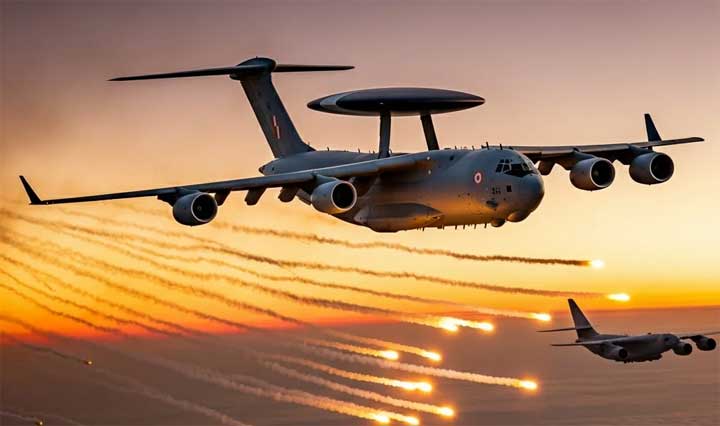
The Ministry of Defence is set to approve a proposal for the acquisition of six additional Embraer aircraft from Brazil, which will be converted into Airborne Early Warning and Control (AEW&C) platforms.
These aircraft will be equipped with the DRDO-developed Netra Mark 1A AESA radars to plug critical capability gaps and enhance India’s conventional deterrence. The proposal is expected to be presented to the Defence Acquisition Council (DAC), which is chaired by Defence Minister Rajnath Singh, in the near future.
In addition to this, the government has approved a wet lease for one KC-135 mid-air refueller from the US-based Metrea military contractor. Furthermore, the Defence Ministry has expedited the process for acquiring six more mid-air refuellers based on a Request for Proposal (RFP) issued by its acquisition wing. Currently, India operates six Russian-made IL-78 M refuellers.
The need for the AEW&C aircraft is particularly urgent given the capabilities of the Pakistan Air Force (PAF). The PAF currently operates eight SAAB-2000 aircraft equipped with the Erieye radar system, along with four Chinese ZDK-03 aircraft designed for electronic warfare and support measures. Pakistan also uses three Dassault Falcon DA-20 aircraft for electronic warfare. Notably, during the 2025 Operation Sindoor, one of Pakistan’s SAAB-2000 Erieye AEW&C aircraft was shot down by India’s S-400 air defense system at a range of 314 kilometers. AEW&C aircraft play a vital role by offering long-range surveillance, detecting enemy aerial threats, and identifying artillery fire from a distance of up to 350 km.
Pakistan also operates four Russian IL-78 M mid-air refuellers, similar to India’s current fleet.
Following Operation Sindoor, India’s military chiefs and national security planners convened on June 7, 2025, to review the lessons learned. A consensus emerged that India must strengthen its capabilities, especially since Pakistan is expected to enhance its military capabilities with support from China. This includes the acquisition of Yuan-class diesel submarines, frigates, and armed drones from China, as well as assistance from Turkey in building corvettes, upgrading Augusta 90B submarines, and providing spare parts for F-16 aircraft.
India is also assessing weaponry recovered from the skirmish, including Chinese-made PL-15 air-to-air missiles, Fatah rockets, and Turkish-built YIHA drones. Indian technology experts are analyzing these weapons, which have provided valuable insights into Chinese systems such as the J-10, JF-17 fighters, HQ-9 air defense systems, and SH-15 howitzers, as well as the performance of India’s Rafale fighters in live conditions.
India’s post-Sindoor assessment has also raised concerns about the potential for future mass-casualty attacks by Pakistan-based jihadist groups. The Pakistan military is likely to be better prepared for future responses to Indian countermeasures, including terrorism-related scenarios.
During the May 7–10, 2025 clash, Indian forces bombed nine terror camps across Pakistan and PoK, killing at least 100 terrorists. The Indian Air Force also struck 13 Pakistani airbases and military installations. New information has revealed that India’s strikes on Pakistani soil were more extensive than previously known, with drone attacks reaching locations as far north as Peshawar and as far south as Hyderabad.
In response, Pakistan launched Operation Bunyan-um-Marsoos, aimed at retaliating against Indian actions. However, it was quickly brought to a halt, folding in just eight hours, far short of Islamabad’s ambitious goal to subdue India in 48 hours. This swift collapse highlighted the limited success of Pakistan’s counteroffensive. Indian Chief of Defence Staff, General Anil Chauhan, noted that the operation’s failure was a testament to the resilience and effectiveness of India’s military response.
Operation Sindoor, which began on May 7 and ended on May 10, 2025, was India’s military retaliation to a deadly terror attack in Pahalgam that claimed the lives of 26 people.
Comments are closed.