
Hurricane Melissa Strengthens to Category 4, Could Hit Category 5 as It Nears Jamaica and Cuba

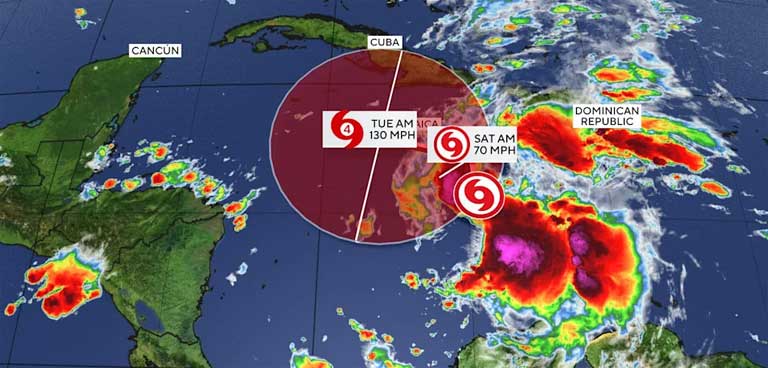
A rapidly intensifying Hurricane Melissa strengthened into a Category 4 storm on Sunday, with U.S. forecasters warning it could reach Category 5 strength as it barrels toward the northern Caribbean, threatening catastrophic flooding across Jamaica, Haiti, and Cuba.
The U.S. National Hurricane Center (NHC) said Melissa is expected to pass near or over Jamaica early Tuesday as a major hurricane before striking Cuba on Tuesday night and then crossing the southeastern Bahamas on Wednesday.
“Conditions in Jamaica are going to deteriorate rapidly,” said Jamie Rhome, the NHC’s deputy director. “Be ready to ride this out for several days.”
As of Sunday night, Melissa was centered about 115 miles (185 km) south-southwest of Kingston, Jamaica, with maximum sustained winds of 145 mph (230 kph). Moving west at just 5 mph (7 kph), the slow pace raised fears of prolonged heavy rainfall and flooding.
Torrential Rains and Widespread Damage Expected
Forecasters warned of up to 30 inches (760 mm) of rain across Jamaica and southern Hispaniola—with isolated areas possibly receiving as much as 40 inches (1,010 mm). The NHC cautioned that the deluge could trigger severe flooding, landslides, power outages, and widespread infrastructure damage, potentially isolating entire communities.
In Cuba, Melissa is expected to dump up to 12 inches (300 mm) of rain when it reaches the island late Tuesday. The Cuban government has issued hurricane warnings for the eastern provinces of Granma, Santiago de Cuba, Guantánamo, and Holguín, and tropical storm warnings for Las Tunas.
Jamaica Closes Airports, Opens Shelters
Both of Jamaica’s main airports — Norman Manley International in Kingston and Sangster International in Montego Bay — were closed Sunday as authorities rushed to prepare for impact.
Evacuations were ordered in Old Harbour Bay, a flood-prone coastal community in St. Catherine Parish, amid reports that some residents were reluctant to leave.
Desmond McKenzie, head of Jamaica’s national disaster response, said all 650 emergency shelters across the island were open and stocked. “We are ready to respond,” he said, adding that food supplies and aid packages had been pre-positioned in warehouses nationwide.
Meteorological Service of Jamaica chief Evan Thompson warned that storm surges and flash floods could affect “every parish of our country.” He urged residents in low-lying or riverbank areas to move immediately to safer ground.
Students Sheltered, Foreign Governments on Alert
Foreign governments also took precautions. Antigua and Barbuda relocated its students studying in Jamaica to a hotel in Kingston for safety. “They have better backup systems here,” said Jewel Moore, a 19-year-old chemistry student at UWI Mona. “The passing of the storm should be okay — it’s getting out afterward that will be the problem.”
Fatalities Reported in Haiti and the Dominican Republic
Melissa’s slow and erratic movement has already turned deadly. At least three people were killed in Haiti after a wall collapsed amid rising waters, while another fourth person died and one remains missing in the Dominican Republic, officials said.
Flooding and overflowing rivers have destroyed bridges, damaged nearly 200 homes, and cut off dozens of communities in both countries. In the Dominican Republic, more than half a million people were left without water after supply systems were damaged.
Next Path: The Bahamas and Beyond
The Bahamas Department of Meteorology warned that Melissa could bring tropical storm or hurricane conditions to parts of the southeastern and central Bahamas and the Turks and Caicos Islands by midweek.
Melissa is the 13th named storm of the 2025 Atlantic hurricane season, which runs from June 1 to November 30. The U.S. National Oceanic and Atmospheric Administration (NOAA) has forecast an above-normal season, with up to 18 named storms expected.
Comments are closed.