
How Pope Leo’s Visit to Lebanon Offers Hope Amid Crisis and Insecurity
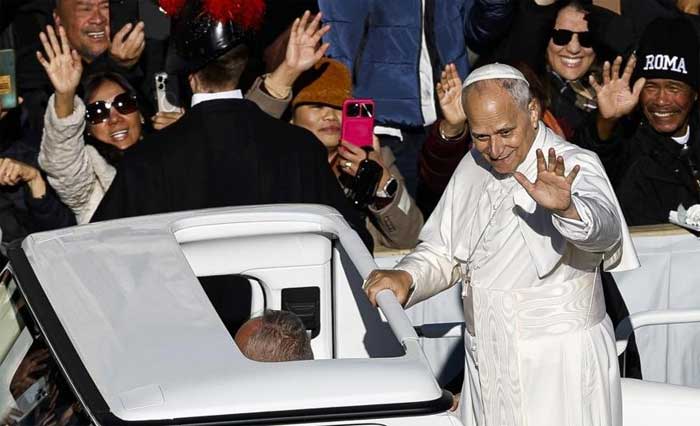
Pope Leo XIV arrived in Lebanon on Sunday for a three-day visit that officials have called “historic in timing and content,” coming amid fears that the year-old ceasefire between Israel and Hezbollah could collapse and plunge the region into a new phase of violence.
The Pope’s tightly scheduled itinerary includes meetings with senior political leaders, visits to major Christian sites such as the Monastery of Saint Maron in Annaya and the Shrine of Our Lady of Lebanon in Harissa, and a solemn moment of prayer at the site of the devastating Aug. 4, 2020 Beirut port explosion. He will meet survivors and victims’ families and is expected to renew calls for justice nearly five years after the blast.
Leo will also visit the Sisters of the Cross Hospital in Jal El-Dib, meet with youth groups, and preside over a large open-air mass at the Beirut waterfront attended by leaders from multiple Christian and Muslim communities.
A message of peace amid crisis
The Vatican has framed the trip as a gesture of solidarity with all Lebanese, and particularly with the country’s struggling Christian community. Before departing Rome, Leo said simply: “Lebanon has suffered enough,” and chose “Blessed are the peacemakers” as the visit’s motto.
Maronite Patriarch Bechara Boutros Al-Rahi said the visit offers “a fresh look at a country left alone to its fate,” and stressed that the Pope carries “a message of peace and hope” to a population exhausted by political paralysis, economic collapse and regional instability. He urged Lebanese leaders to accompany the Pope’s message with decisive national action.
Al-Rahi said he hopes Leo’s meeting with Lebanese youth will ease the “war within the hearts of an entire generation tired of collapse, emigration and futility,” encouraging them to become “peacemakers” by choosing to remain and rebuild.
Interfaith significance
Mohammad Al-Sammak, secretary-general of Lebanon’s National Islamic-Christian Dialogue Committee, emphasized that the trip coincides with the Church’s commemoration of Nostra Aetate, the landmark Vatican II document that redefined Catholic relations with other faiths, particularly Islam. He said the visit “rings an internal bell” for Lebanon to reclaim its role as a model of coexistence.
While Lebanon has long presented itself as a champion of pluralism, Al-Sammak noted that its political crises have eroded that image. Still, he said, the Vatican “is not giving up on Lebanon” and hopes Leo XIV’s visit will give new momentum to its mission as “the country of the message.”
Broad political reactions
Preparations for the visit have intensified across churches, monasteries and state institutions. Roads leading to key sites have been renovated and adorned with Vatican and Lebanese flags. Organizers say 120,000 people—including thousands of Muslims—have registered to take part.
Christian political parties urged supporters to fill the streets “to show the world that Lebanon has a vibrant Christian presence.” Kataeb Party leader Sami Gemayel said the visit carries a message of “openness, peace and stability,” adding that Lebanon must “turn the page on bloodshed” and work to restore its standing as “the Switzerland of the East.”
Others saw geopolitical weight in the visit. The Syrian Social Nationalist Party, aligned with Hezbollah, called the Pope’s presence “a voice for truth” against “the barbarism of the Zionist occupation.” MP Elias Jarada urged the Vatican to add a stop in southern Lebanon to show solidarity with communities “suffering from continuous Israeli aggression.”
Logistics and security
Leo’s visit runs through Dec. 2 and includes a mix of official, religious and public events. The Republican Guard Brigade is responsible for securing the Pope and his delegation. The Ministry of Defense has suspended weapons licenses in Beirut and Mount Lebanon, and 21 artillery rounds will be fired upon his arrival.
Authorities warned the public not to bring flammable materials or use drones near papal sites. All access points will include security checks.
The Presidential Palace said 1,350 journalists from Lebanon, the Arab world and abroad have registered to cover the trip. The government has declared Monday and Tuesday public holidays.
The Internal Security Forces announced road closures and arranged hundreds of buses from regions including Keserwan, Chouf, Bekaa, Jbeil, Batroun, Metn, Beirut, and the northern and southern governorates.
Organizers said the altar for the waterfront mass will feature a special logo symbolizing Lebanon’s heritage—from its cedars and crafts to its culture, family spirit and tradition of resilience.
Tourism boost
Hotels in Beirut and along the coast to Jounieh have reported a rise in reservations linked to the visit, according to Pierre Al-Achkar, president of the Lebanese Hotel Owners Association. Bookings include Syrian, Iraqi and Jordanian visitors, international journalists, and religious orders staying in monasteries. He added that demand has remained strong despite recent Israeli threats and strikes in Lebanon’s south.
Comments are closed.