
High-Stakes US–Russia Talks Fail to Break Deadlock as Moscow Refuses Compromise on Ukraine Territories

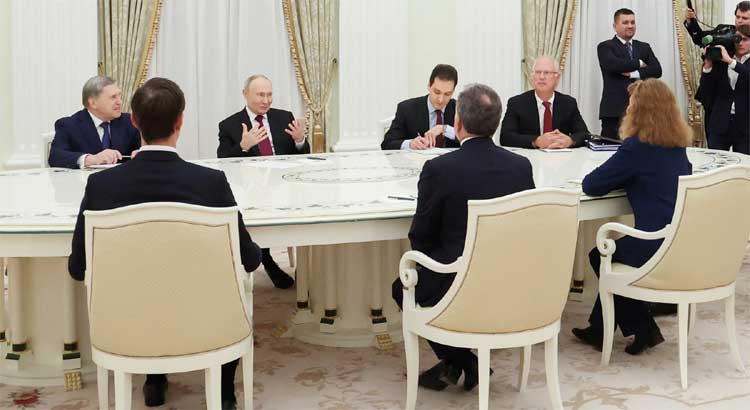
High-level talks in Moscow aimed at ending the nearly four-year war in Ukraine ended without a breakthrough on Tuesday, with the Kremlin declaring that “no compromise” had been reached on the crucial issue of territory. The failed discussions mark another setback in ongoing diplomatic efforts to halt a conflict that has killed thousands, displaced millions, and reshaped global geopolitics.
Russian President Vladimir Putin met with U.S. presidential adviser Jared Kushner — son-in-law to President Donald Trump — and special envoy Steve Witkoff in the Kremlin. Despite the high-profile nature of the talks, Moscow made clear that it is not ready to concede on key territorial demands.
No Agreement on Occupied Territories
Top Kremlin aide Yuri Ushakov said the two sides remained divided on the status of territories Russia has seized since launching its offensive in February 2022.
“So far we haven’t found a compromise, but some American solutions can be discussed,” he said, adding that “work will continue.”
He noted that while a few points in the revised U.S. peace plan were acceptable, Putin expressed a “critical, even negative” stance on several others.
The U.S. plan—which has already been amended in response to strong pushback from Kyiv and European allies—was broken into four parts and debated during a marathon five-hour meeting.
Kyiv Warns Against Backdoor Deals
Ukrainian President Volodymyr Zelensky has been firm that any peace proposal must fully end the war, not merely freeze the conflict.
“There will be no simple solutions,” Zelensky said, insisting that nothing be decided “behind Ukraine’s back.”
He highlighted that the most contentious issues include territorial control, frozen Russian assets, and Ukraine’s long-term security guarantees.
Putin Sends a Hardline Signal
Just hours before the talks began, Putin delivered a hawkish message, boasting about the capture of Pokrovsk—an eastern Ukrainian stronghold.
He called it a “good foothold” for achieving Moscow’s original war objectives, reinforcing doubts about Russia’s willingness to negotiate significant concessions.
Ukraine, meanwhile, faces mounting pressure on multiple fronts: rapid Russian advances, intensifying missile and drone strikes that have left hundreds of thousands without heat or electricity, and internal political turmoil following corruption scandals involving top officials.
US Acknowledges Difficult Path Ahead
President Trump, speaking at a White House cabinet meeting, admitted the negotiations were “not an easy situation.”
“Our people are over in Russia right now to see if we can get it settled. What a mess,” he said.
Zelensky has suggested that Russia’s motivation for engaging in talks may be tied to its desire to ease Western sanctions — a sentiment shared by several European officials.
Europe on Edge Over Potential Side Deals
European leaders remain concerned that Washington and Moscow could strike an agreement unfavorable to Kyiv. Such fears intensified after the original 28-point U.S. plan appeared to align closely with Russian demands — prompting accusations, which Washington denies, that Moscow influenced the document.
Compounding these concerns, a Bloomberg report revealed an audio recording suggesting that Witkoff had coached Russian officials on how Putin should communicate with Trump.
Tuesday’s meeting also marked the first time Jared Kushner — who earlier this year helped broker a ceasefire between Israel and Hamas — joined negotiations with Putin, signaling the high stakes the U.S. attaches to the effort.
Uncertain Road Ahead
Though Ushakov called the talks “useful,” neither side made concrete progress toward a settlement. The fundamental disagreements — particularly over territorial control and security guarantees — remain unresolved.
As Moscow signals readiness to continue its campaign and Ukraine braces for further pressure, hopes for a near-term ceasefire continue to dim. The latest round of talks underscores just how difficult bringing an end to the conflict will be — and how precarious the diplomatic landscape has become.
Comments are closed.