
Heard Island Glaciers Retreating Rapidly Amid Global Climate Crisis, New Research Finds

Heard Island and the McDonald Islands—remote, uninhabited Australian territories in the Southern Ocean—have found themselves in global headlines after being bizarrely included in U.S. President Donald Trump’s sweeping “Liberation Day” tariffs announced on April 2. Despite lacking a local population, tourism, agriculture, or trade, these UNESCO World Heritage-listed islands are now the unlikely focal point of both political and environmental discussions.
But beyond the tariff oddity lies a much deeper concern: Heard Island’s glaciers are melting at an alarming rate, according to a groundbreaking new study from Monash University’s Securing Antarctica’s Environmental Future (SAEF) program.
A Climate Bellwether in the Southern Ocean
Led by Dr. Levan Tielidze, Professor Andrew Mackintosh, and Dr. Weilin Yang, the study—published in The Cryosphere—offers the most detailed mapping to date of Heard Island’s glacial landscape. Drawing on topographical data from 1947 and satellite imagery spanning more than 70 years, researchers catalogued 29 glaciers and found that 23.1% of the island’s ice cover—about 64 square kilometers—has disappeared since 1947.
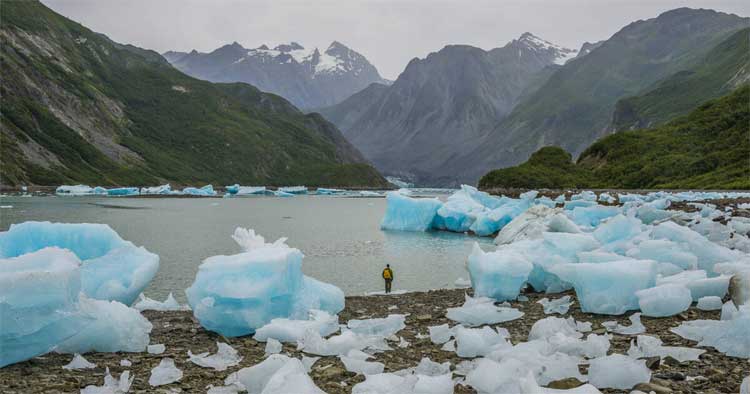
The retreat is most dramatic at Stephenson Glacier, which has shrunk by 5.8 km, giving rise to a newly formed lagoon where ice once met the sea. The study also recorded a significant increase in surface debris and an elevation shift in ice coverage, correlating with a regional temperature rise of 0.7°C.
“Heard Island is as remote as it gets, yet the impact of climate change is unmistakable,” said Dr. Tielidze. “These findings reflect a broader climate reality driven by rising greenhouse gas emissions over the last century.”
Uncovering Life After the Ice
The team’s work doesn’t stop with glacial data. They’re also tracking how biodiversity responds as the ice recedes. Professor Mackintosh’s team has secured an ARC Discovery Project grant to study how shrinking glaciers threaten mountain ecosystems. As new land is exposed, researchers are observing how plants, animals, and freshwater systems adapt to the changing landscape.
“Glacier retreat transforms habitat availability,” says Dr. Tielidze. “The new inventory will help us monitor how ecosystems develop in these emerging environments.”
Later this year, SAEF scientists will travel aboard the RSV Nuyina as part of the Australian Antarctic Program to collect bedrock samples newly exposed by ice loss. These samples will be analyzed for cosmogenic isotopes, which can reveal whether today’s glacier retreat is historically unprecedented.
A Global Wake-Up Call
The research underscores Heard Island’s role as a vital climate indicator. Its location in the Southern Ocean places it within a key global climate system, making it a powerful barometer for Earth’s environmental health.
“This stark retreat shows that further glacier loss is now inevitable,” says Professor Mackintosh. “Whether we retain these glaciers, or lose them entirely, depends on the greenhouse gas emissions path we choose from here.”
The findings highlight a sobering truth: even Earth’s most remote places are not insulated from human impact. And that reality brings with it a global responsibility.
“This tiny island offers a huge warning,” Dr. Tielidze adds. “Preserving its unique biodiversity depends on the choices we make—now.”
Comments are closed.