
He came, met Modi, and left: UAE President’s three-hour Delhi visit sparks buzz

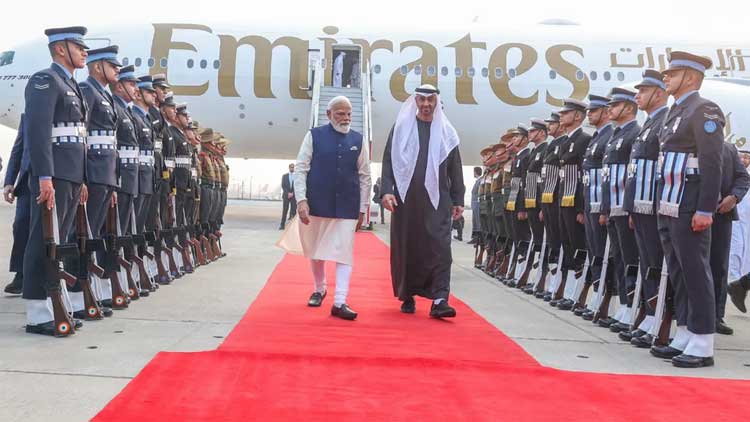
He came, he sparked speculation, and he left. That, in a nutshell, was how a section of social media described United Arab Emirates President Sheikh Mohamed bin Zayed Al Nahyan’s brief visit to New Delhi on Monday, with the unusually short duration fuelling questions about its purpose and urgency.
Popularly known as MBZ, the UAE President landed in the Indian capital on Monday evening and departed within a few hours. Conflicting reports suggested his stay lasted anywhere between under two hours and about three hours, prompting online theories about what many perceived as an extraordinary diplomatic dash.
However, a joint statement issued by India and the UAE later sought to dispel speculation, making it clear that the visit was neither sudden nor unplanned. It noted that Sheikh Mohamed bin Zayed Al Nahyan travelled to India “at the invitation of” Prime Minister Narendra Modi and that the meeting resulted in a series of concrete outcomes—unlikely to have been negotiated in a matter of hours.
Social media buzz over a brief visit
The brevity of the visit, combined with the size and seniority of the UAE delegation, became a talking point online.
“An intriguing visit. State visits usually last a day or more. UAE visit had virtually all important ministers. Visit lasted just a few hours. Highly unusual. Gives the appearance of extreme importance and urgency,” one user wrote on X.
“MBZ brought almost everyone that matters in the UAE along with him for a two-hour visit. Something significant happened yesterday,” another post read.
The significance, however, was later outlined in official readouts from both governments.
Terror condemnation, defence ties strengthened
According to a statement issued by pmindia.gov.in, the UAE President’s visit on January 19, 2026, marked his fifth visit to India in the past decade and his third official visit as President of the UAE.
During talks, Prime Minister Modi and Sheikh Mohamed bin Zayed Al Nahyan reviewed the full spectrum of bilateral ties and agreed that the India–UAE Comprehensive Strategic Partnership had deepened steadily over the past ten years.
Both leaders “reiterated their unequivocal condemnation of terrorism in all its forms and manifestations, including cross-border terrorism,” and emphasised that no country should provide safe haven to individuals or entities involved in financing, planning or carrying out terrorist acts.
They also agreed to continue cooperation under the Financial Action Task Force (FATF) framework to counter terror financing and strengthen anti–money laundering mechanisms.
A key outcome of the meeting was the signing of a Letter of Intent towards a Strategic Defence Partnership, reinforcing defence and security cooperation as a core pillar of bilateral relations.
Key agreements and outcomes
Ministry of External Affairs spokesperson Randhir Jaiswal later shared a list of 12 outcomes from the meeting. These included:
-
Steps towards a Strategic Defence Partnership
-
Promotion of bilateral civil nuclear cooperation
-
A sales and purchase agreement between Hindustan Petroleum Corporation Limited (HPCL) and ADNOC Gas
-
Several Letters of Intent, Memorandums of Understanding and agreements across sectors
Prime Minister Modi also shared a photograph with the UAE delegation, highlighting the presence of senior leaders including the Crown Prince of Dubai Sheikh Hamdan bin Mohammed Al Maktoum, UAE Foreign Minister Sheikh Abdullah bin Zayed Al Nahyan, and other key members of the Emirati leadership.
Before departing, MBZ posted on X that he was pleased to meet Prime Minister Modi to “discuss opportunities to further strengthen the deep-rooted and historical ties of cooperation” between India and the UAE. He added that both countries remained committed to driving sustainable development and economic growth in future-focused sectors.
Regional backdrop: Saudi–UAE frictions
The visit also unfolded against a complex regional backdrop, with Saudi Arabia and the UAE—once close allies—facing growing tensions driven by policy differences and strategic competition.
These include disagreements over oil production within OPEC+, competing economic visions to become the region’s leading business hub, and divergent approaches to regional issues such as Yemen, Iran and relations with global powers.
On Monday, the Saudi-backed Yemeni government accused the UAE of operating a secret prison at an airbase near the port city of Mukalla—an allegation Abu Dhabi has denied. The claim, reported by Reuters, added to the strain in relations between the two Gulf oil states.
While the brevity of MBZ’s Delhi visit captured online attention, the official outcomes suggest a meeting focused less on optics and more on reinforcing strategic priorities at a moment of shifting regional and global dynamics.
Comments are closed.