
Global Markets Plunge as Trump Unleashes Sweeping New Tariffs; $243 Billion in Trade at Risk

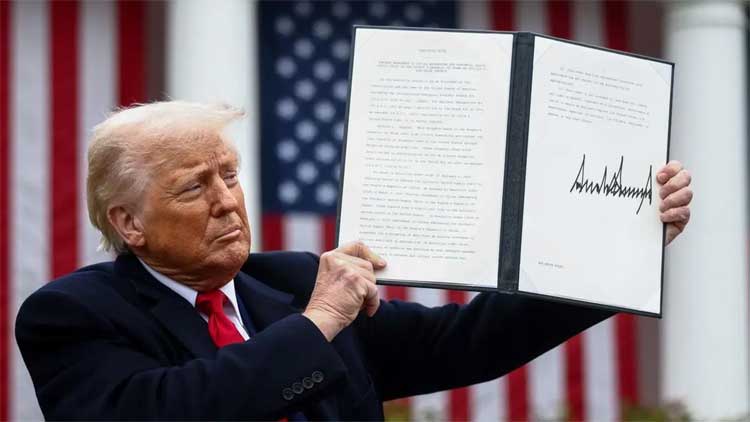
U.S. President Donald Trump’s sweeping new wave of tariffs on dozens of trade partners rattled global markets on Friday and left governments and businesses scrambling for damage control. The tariffs—some of the highest seen since the 1930s—affect 69 countries and include rates as high as 50% on Brazil, 39% on Switzerland, 35% on Canada, 25% on India, and 20% on Taiwan.
Trump’s order, which takes effect August 7 at 0401 GMT, pushes the effective U.S. tariff rate to nearly 18%, up from just 2.3% last year, according to Capital Economics. The move sent global stocks tumbling, with the Dow Jones down 1.23%, S&P 500 off 1.6%, and the Nasdaq sinking 2.24%. Europe’s STOXX 600 index dropped 1.89%, reflecting the widespread market panic.
Compounding the volatility was a weak U.S. jobs report, showing unexpectedly slow job growth in July. In a controversial response, Trump fired Bureau of Labor Statistics Commissioner Erika McEntarfer, claiming without evidence that the data was “rigged.”
Global Response: Shock, Retaliation, and Negotiation
Countries hit hardest are seeking talks in hopes of avoiding long-term damage:
-
Switzerland, reeling from a sudden 39% tariff, said it was “stunned” and vowed to push for a negotiated resolution.
-
India, slapped with a 25% tariff affecting an estimated $40 billion in exports, has re-entered trade talks with Washington.
-
South Africa, facing a 30% tariff, is exploring “practical interventions” to protect jobs and industries.
-
Thailand, relieved by a reduced rate of 19% (down from 36%), said the shift helps preserve competitiveness and investor confidence.
-
Australia retained a minimum 10% rate, with Trade Minister Don Farrell saying it could make Aussie exports more attractive in the U.S. market.
Meanwhile, Canada, which had its fentanyl-related tariff rate raised to 35%, was hit particularly hard. Prime Minister Mark Carney criticized the move and promised countermeasures to defend Canadian jobs and diversify export markets.
Trump issued a separate reprieve for Mexico, delaying a 30% tariff on its exports by 90 days to allow further negotiations.
Rising Prices and Industry Fallout
The tariff hikes are already driving up consumer costs. U.S. Commerce Department data showed a 1.3% price spike in home furnishings and household equipment in June—the steepest increase since March 2022.
Major European companies, including L’Oréal, are turning to loopholes like the obscure “First Sale” rule, which allows firms to reduce duties by calculating them based on the product’s factory cost, not its final retail price.
But businesses on both sides of the Atlantic are bracing for broader losses.
“The tariffs hurt the Americans and they hurt us,” said German winemaker Johannes Selbach, warning of job cuts and profit hits.
“There are no real winners in trade conflicts,” added Thomas Rupf, CIO Asia at VP Bank. “Even countries with slightly better terms will see growth dampened.”
White House: Chaos as Leverage
The Trump administration defended the strategy, calling the uncertainty “necessary leverage” to extract better deals. Council of Economic Advisers Chair Stephen Miran said the tariff pressure had already led to “monumental” trade progress, though critics argue most deals remain vague or incomplete.
Trump’s order accused some partners of failing to correct trade “imbalances” or align with U.S. security interests. However, many analysts see the move as disruptive and poorly coordinated, especially with unclear enforcement mechanisms like the 40% penalty on transshipments—goods rerouted to dodge tariffs.
What’s Next?
Despite the uproar, Trump appears determined to reshape global trade on his terms—even at the risk of market instability. The European Union, which struck a framework deal with Washington last week, is still waiting on U.S. follow-through on promised exemptions, including for autos and aircraft.
As businesses brace for the tariffs’ rollout next week, many fear that Trump’s aggressive moves will trigger trade retaliation, fuel consumer price inflation, and undermine fragile global growth.
For now, world leaders are watching and waiting—many with clenched fists and calculators in hand.
Comments are closed.