
G7 Summit Concludes Without Trump as Tensions Rise Over Ukraine, Iran and Trade
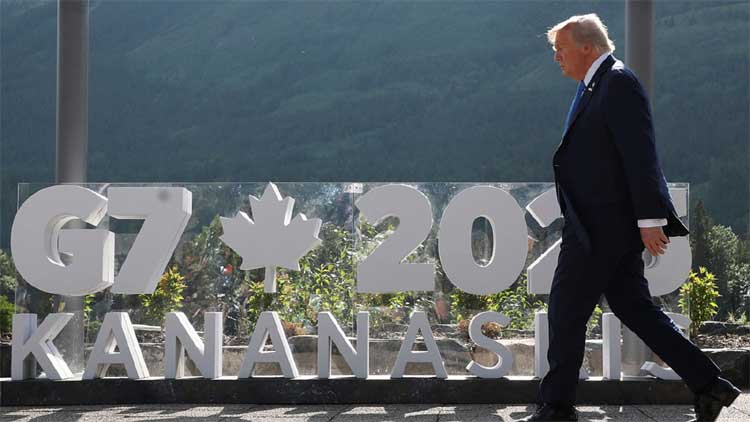
Six leaders of the Group of Seven (G7) wrapped up their summit on Tuesday amid mounting global tensions and the conspicuous early exit of US President Donald Trump, raising questions about the bloc’s unity and influence.
Canadian Prime Minister Mark Carney, joined by leaders from the UK, France, Germany, Italy, and Japan — along with NATO Secretary-General Mark Rutte and Ukrainian President Volodymyr Zelensky — pressed ahead with discussions on the Ukraine war and other global crises, essentially turning the summit into a G6.
Zelensky delivered a stark update on the war, saying that overnight Russian missile attacks had left 15 dead and over 150 injured. “Our families had a very difficult night, one of the biggest attacks from the very beginning of this war,” he said, urging international pressure on Russia. “We are ready for peace negotiations, unconditional ceasefire… but for this, we need pressure.”
Carney pledged $2 billion in new aid for Ukraine, including drones and other military support, calling for “total solidarity with Ukraine.”
While the leaders discussed a range of pressing issues—from the impact of artificial intelligence on jobs and the environment to ensuring fair access to critical minerals—they stopped short of issuing a joint statement on Russia’s war in Ukraine. A planned meeting between Trump and Zelensky was canceled following the US president’s abrupt departure from the summit, held in Kananaskis, Canada.
Before leaving, Trump joined other leaders in a brief joint statement warning that Iran “can never have a nuclear weapon” and calling for “de-escalation of hostilities in the Middle East, including a ceasefire in Gaza.” The statement came amid escalating violence between Iran and Israel, including a fresh round of aerial bombardments and missile strikes.
Trump’s dramatic early exit came after he demanded the evacuation of Tehran and called for Iran’s “unconditional surrender,” further intensifying the geopolitical climate. “We did everything I had to do at the G7,” Trump said aboard Air Force One en route back to Washington.
His absence loomed large over the final day of the summit, with British Prime Minister Keir Starmer confirming he sat next to Trump during Monday’s dinner. “There was agreement in the room on the statement,” Starmer said. However, the atmosphere remained tense, with Italian PM Giorgia Meloni captured on video rolling her eyes as French President Emmanuel Macron whispered to her.
Trump’s refusal to join new G7 sanctions on Russia marked another point of divergence. While the UK, Canada, and others levied new tariffs to pressure Moscow into ceasefire talks, Trump held back. “When I sanction a country, that costs the US a lot of money,” he said.
His continued grievances over trade also took center stage. Trump has imposed steep tariffs—50% on steel and aluminum, 25% on autos, and a 10% general import tax that could increase after July 9, when a self-imposed 90-day review ends. Despite this, he signed a trade framework with Starmer that had originally been announced in May. The moment turned awkward when Trump dropped the signed papers, and Starmer retrieved them.
Explaining the move, Starmer said, “There were quite strict rules about who can get close to the president. I was deeply conscious that anyone else stepping forward might have been shot.”
While Trump’s allies remained in Canada for the closing meetings — including Treasury Secretary Scott Bessent and US Trade Representative Jamieson Greer — the summit’s conclusion was overshadowed by his departure, diverging views on Ukraine, and intensifying global flashpoints.
Kremlin spokesperson Dmitry Peskov mocked the G7 as “very pale and quite useless,” in contrast to the broader G20.
With a fractured consensus, growing trade disputes, and multiple wars escalating, the summit underscored the challenges of global cooperation in a rapidly shifting world — especially in the absence of one of its most polarizing and powerful figures.
Comments are closed.