
From the Balkans to Southeast Asia: High-Stakes Elections Test Fragile Stability Across Three Continents

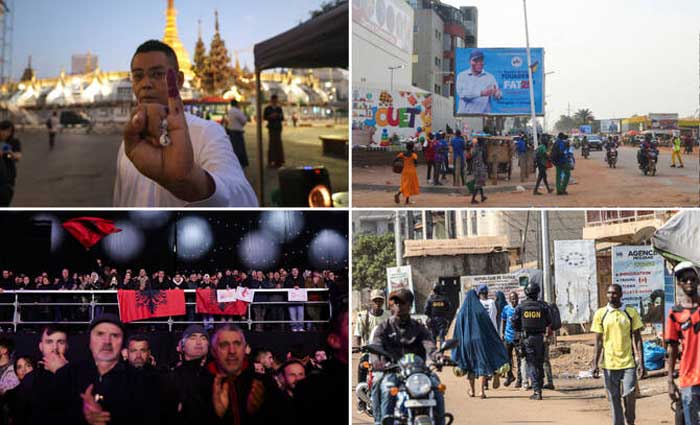
Four countries across three continents — Myanmar, the Central African Republic (CAR), Guinea and Kosovo — went to the polls on Sunday in a high-stakes day for global democracy, with elections unfolding amid conflict, political transitions and institutional deadlock.
While each vote reflects distinct national realities, all carry significant implications for regional stability and the future of civilian governance.
Myanmar: Polls under military control
Myanmar’s ruling junta has presented the election as a step back toward democracy, five years after overthrowing the elected government and plunging the country into civil war. However, turnout appeared thin in junta-controlled areas, with early voting stations drawing more officials and journalists than voters.
The military annulled the 2020 election, jailed civilian leader Aung San Suu Kyi and dissolved her popular National League for Democracy party, which is barred from contesting the vote. Critics, including the United Nations and Western governments, say the month-long, phased election is neither free nor fair, citing widespread repression, the exclusion of opposition forces and heavy military influence.
Voting is taking place only in areas under junta control, with no polling in rebel-held regions. Authorities have warned against any disruption or criticism of the process, prosecuting more than 200 people under strict election laws. The final round of voting is scheduled for January 25.
Central African Republic: Touadera seeks third term
In the Central African Republic, President Faustin-Archange Touadera is seeking a third term after a 2023 constitutional referendum removed presidential term limits. His expected victory would likely strengthen Russian influence in the country, where Moscow-backed mercenaries and Rwandan troops have helped shore up security in exchange for access to natural resources.
Touadera faces six challengers, including former prime ministers Anicet-Georges Dologuele and Henri-Marie Dondra, though analysts say the president’s control over state institutions and resources gives him a decisive advantage. Human rights groups have raised concerns over administrative hurdles faced by opposition candidates.
While security has improved compared to past elections, analysts warn the risk of post-election unrest remains high. Provisional results are expected by January 5.
Guinea: Junta leader poised for civilian mandate
In Guinea, the election is widely expected to formalize the rule of Mamady Doumbouya, who seized power in a 2021 coup. The former special forces commander faces eight other candidates, but lacks a serious challenger, with key opposition figures in exile.
Doumbouya has boosted his popularity through resource nationalism and promises of economic reform, particularly tied to Guinea’s vast bauxite reserves and the long-delayed Simandou iron ore project. However, rights groups and the UN have criticised the tightly controlled political environment, citing restrictions on protests, media freedom and opposition activity.
About 6.7 million Guineans are registered to vote, with provisional results expected within three days.
Kosovo: Vote to break political deadlock
In Kosovo, voters are hoping the election will end a year-long political stalemate that has paralysed parliament and delayed critical international funding. Prime Minister Albin Kurti’s Vetevendosje party is seeking a majority after failing to form a coalition earlier this year.
The impasse has stalled key decisions, including the ratification of €1 billion in loans from the European Union and World Bank. Relations with Western allies and tensions in the Serb-majority north have dominated the campaign, with both government and opposition promising economic reforms.
With opinion polls banned, the outcome remains uncertain, and voter disillusionment is widespread in Europe’s youngest nation.
Together, Sunday’s elections highlight the uneven state of democracy worldwide — from tightly controlled ballots under military rule to contested votes aimed at restoring political stability.
Comments are closed.