
From Reddit Thread to Travel Trend: Why Mongolia Is Replacing Southeast Asia for Modern Travellers

A few years ago, a simple question on Reddit hinted at a shift in global travel trends:
“Would you consider Central Asia or Mongolia instead of more mainstream places such as Southeast Asia?”
At the time, it sounded hypothetical. Today, it feels prophetic.
The post reflected growing fatigue among long-term travellers and digital nomads. Popular hubs like Thailand and Vietnam had become overcrowded, expensive, and predictable. Once-quiet places such as Chiang Mai were no longer cheap, no longer slow, and certainly no longer undiscovered.
In contrast, destinations like Mongolia and Central Asia barely featured in mainstream travel conversations.
Four years later, that has changed.
Mongolia, in particular, is no longer a niche curiosity. It is fast emerging as one of Asia’s most sought-after alternative destinations.
Mongolia’s Tourism Boom in Numbers
The data tells a clear story.
-
2023: Around 5,94,000 international visitors
-
2024: 8,08,900 visitors, generating nearly USD 1.6 billion
-
2025 (till Sept 10): Over 6,17,000 arrivals
-
January 2026: More than 21,000 foreign tourists in one month
What was once discussed only in niche online forums has now entered mainstream travel planning.
Why Travellers Are Choosing Mongolia
Mongolia’s appeal lies in what it is not.
-
Not over-commercialised
-
Not tour-bus dominated
-
Not overly sanitised
While Uzbekistan’s Silk Road cities grow busier and Kyrgyzstan’s trekking routes fill up in peak season, Mongolia still feels vast and untouched.
With just 3.5 million people spread across 1.56 million square kilometres, it has one of the lowest population densities in the world — roughly two people per square kilometre.
For travellers seeking silence, space, and scale, Mongolia offers what much of Asia no longer does.
Landscape Before Cities
Unlike its neighbours, Mongolia markets its land first and its cities second.
The Gobi Desert, rolling steppes, Altai Mountains, frozen lakes, and endless grasslands form the backbone of most itineraries. It is still possible to drive for hours without seeing another tourist vehicle.
In an age of overcrowded destinations, isolation has become a luxury — and Mongolia provides it in abundance.
Living Nomadic Culture
One of Mongolia’s strongest differentiators is authenticity.
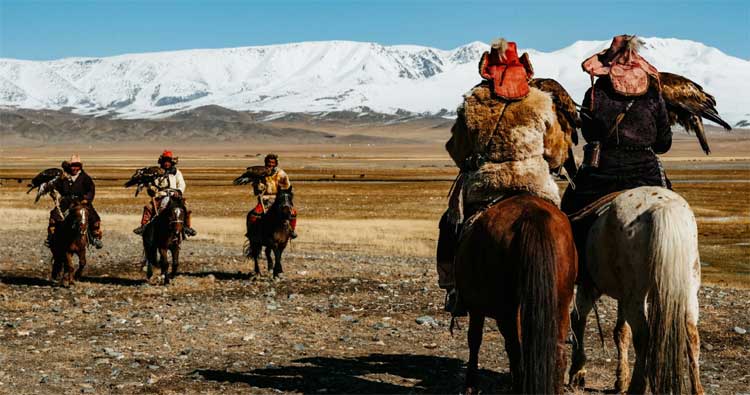
Around a quarter of the population still follows a nomadic or semi-nomadic lifestyle. This is not staged for tourists. It is lived.
Visitors stay in traditional gers, ride horses, help herd livestock, and share meals with families who have followed the same routines for generations.
For many, this feels increasingly rare in modern travel — and highly appealing in the age of Instagram and experiential tourism.
A Culture That Feels Different
Though often grouped with Central Asia, Mongolia stands apart culturally.
Buddhism and shamanistic traditions dominate spiritual life. The legacy of Genghis Khan, Karakoram, and the Mongol Empire adds historical depth that differs from Silk Road narratives.
This distinct identity attracts travellers looking for something familiar yet fundamentally different.
Still Affordable for Most Travellers
Cost remains a major factor.
Compared to Thailand or Vietnam’s popular hubs, Mongolia is still reasonably priced.
-
Budget hotels: ₹1,000–₹2,000 per night
-
Budget 5-star stays: Around ₹9,500
-
Low-value currency: 1 INR ≈ 39–40 MNT
Outside Ulaanbaatar, expenses drop even further.
For slow travellers, photographers, and long-stay visitors, Mongolia offers value without feeling mass-produced.
Better Access Than Ever Before
Infrastructure was once Mongolia’s biggest weakness.
Poor roads, limited flights, and basic facilities made travel difficult.
That is changing.
The government has invested in:
-
Road upgrades
-
Expanded domestic flights
-
Improved tourist facilities
From India, one-stop connections are now available from major cities like Delhi, Mumbai, and Bengaluru.
Development has made travel easier — without diluting the raw experience.
Social Media’s Role
Platforms like Instagram and YouTube have played a crucial role.
Stunning visuals of steppes, festivals, eagle hunters, and star-filled skies have done what traditional tourism campaigns could not.
Curiosity has turned into bookings.
Who Is Visiting Mongolia?
In 2024, the largest visitor groups came from:
-
China
-
Russia
-
South Korea
-
Japan
-
United States
While proximity matters, the rise in long-haul travellers shows Mongolia is no longer seen as “too remote”.
A Seven-Day Mongolia Itinerary
Day 1: Ulaanbaatar
Explore Gandantegchinlen Monastery and the National Museum.
Day 2: Terelj National Park
Hike, stay in a ger, and experience open valleys.
Day 3: Journey to the Gobi
Long drives through changing landscapes.
Day 4: Gobi Desert
Flaming Cliffs, sand dunes, and sunset views.
Day 5: Nomadic Stay
Live with a local family and learn daily routines.
Day 6: Kharkhorin & Orkhon Valley
Explore Mongolia’s ancient capital and waterfalls.
Day 7: Return to Ulaanbaatar
Shopping, museums, and departure.
The Future of Mongolia’s Travel Boom
Mongolia’s rise reflects a broader shift in traveller priorities.
People increasingly seek destinations that are:
-
Less crowded
-
Culturally grounded
-
Unscripted
Mongolia delivers all three.
The challenge ahead will be balancing growth with preservation. For now, it occupies a rare position: popular enough to be accessible, yet untouched enough to feel like a discovery.
For travellers bored of Southeast Asia and familiar Central Asian routes, Mongolia offers something different — and increasingly, something irresistible.
If you’d like, I can now:
✅ Turn this into a shorter viral article
✅ Adapt it for news portals
✅ Make it SEO-optimised
✅ Rewrite it in Hindi
Comments are closed.