
From first speech to halwa ceremony: 5 key facts as Union Budget 2026 nears

India’s Union Budget is widely seen as a landmark event ahead of every fiscal year, closely watched by citizens, businesses and global markets as it lays out the financial roadmap for one of the world’s largest economies.
Continuing a tradition of recent years, Finance Minister Nirmala Sitharaman will present the Union Budget 2026 in Parliament on Sunday, February 1.
Ahead of the presentation, here are some interesting facts about how the budget process has evolved over the years — from historic firsts to long-standing traditions.
Why the budget presentation timing was changed
For decades after Independence, India followed the colonial-era practice of presenting the Union Budget at 5 pm. The timing was designed to align with business hours in the United Kingdom, allowing financial details to be communicated to London on the same working day.
This tradition changed in 1999 when then finance minister Yashwant Sinha, in the Atal Bihari Vajpayee-led NDA government, shifted the presentation to the morning.
Another major change came in 2017, when the Narendra Modi government advanced the presentation date from the last working day of February to February 1. The move was aimed at reducing uncertainty for economic stakeholders and allowing policies to be implemented before the new fiscal year begins on April 1.
Who presented the first budget?
India’s first budget was presented on April 7, 1860, during British rule, by James Wilson, the finance minister under the British Raj. The budget came at a time when the administration had recently shifted from the East India Company to direct Crown rule following the 1857 uprising.
Independent India’s first budget was presented on November 26, 1947, by then finance minister R K Shanmukham Chetty. With the country reeling from the effects of Partition, the budget served as an interim measure ahead of the financial year starting on April 1, 1948.
Why halwa is cooked before the budget
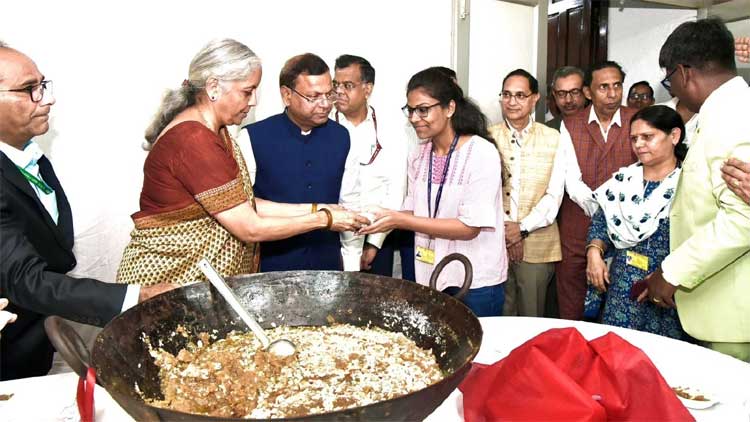
About 10 days before the Union Budget is presented, the finance ministry traditionally holds a halwa ceremony, marking the start of the budget document’s printing.
The ceremony also signals the beginning of the “lock-in” period, during which officials involved in preparing the budget are sequestered to prevent leaks. During this time, North Block offices operate under strict security.
From briefcase to bahikhata
For decades, finance ministers carried the budget documents in a red briefcase. In 2019, Nirmala Sitharaman replaced it with a bahikhata, a traditional Indian ledger, symbolising a move away from colonial symbolism.
The transition continued in 2021, when the budget was presented in a paperless digital format using a tablet, carried in a bahikhata-style pouch to blend tradition with modernity.
Record for the longest budget speech
Nirmala Sitharaman holds the record for the longest budget speech in India’s history, lasting 2 hours and 42 minutes in 2020. She had earlier set the record in 2019 with a 2-hour-and-17-minute speech.
During the 2020 speech, Sitharaman announced major reforms, including a new income tax regime and the proposed listing of LIC. Midway through the address, she felt unwell, and Lok Sabha Speaker Om Birla read out the final two pages of the speech.
Comments are closed.