
Fresh threat as lake near China border begins to overflow; rescue ops on hold as death toll reaches 472

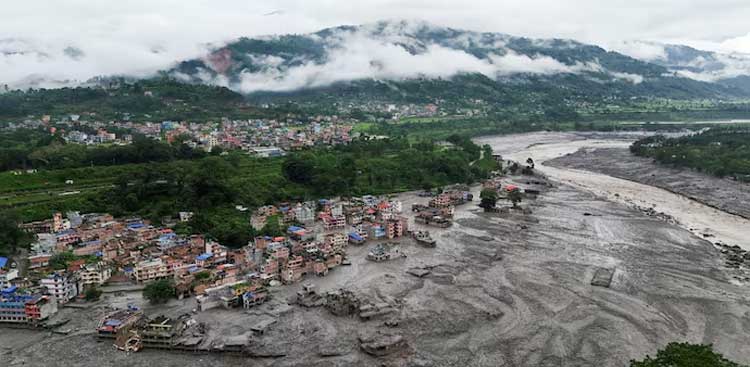
A natural dam upstream of China’s Gyirong border port has begun overflowing, prompting authorities to temporarily suspend rescue operations, state broadcaster CCTV reported. The barrier lake formed after debris blocked a river following the devastating floods in Nepal and Tibet, raising fears of another wave of flooding downstream.
Nepal floods: Death toll reaches 472
At least 472 people have died and around 1,500 remain missing after powerful flood surges and landslides swept through Nepal’s Bhotekoshi and Trishuli river regions earlier this week.
Rescue teams continue to search for survivors, with the death toll expected to rise as teams reach some of the worst-hit areas.
As of Thursday night, 290 Indians remained uncontactable in Nepal, while 84 Indians had been rescued. They included 63 workers from the Trishuli-I hydropower project and 21 people from Tamil Nadu.
China issues fresh flood warning
China’s Ministry of Water Resources has warned of another flood threat after a barrier lake formed near the confluence of the Chhochen Khola and Purepu Tsangpo rivers in Nepal.
The lake contained around 2 million cubic metres of water as of Thursday morning and could breach as additional water flows into it. If the natural debris barrier collapses, a large volume of water could rush downstream towards Nepal, creating a fresh flood threat as the country continues to grapple with the earlier disaster.
What happened in Nepal?
Nepal was struck by devastating flash floods on August 26, particularly in Rasuwa district near the Nepal-China border.
Floodwaters tore through the Bhotekoshi and Trishuli river corridors, destroying homes, roads, bridges and other infrastructure.
Nearly 300 Indian tourists were initially reported missing. Nepal Foreign Minister Shisir Khanal said Thursday that the number was close to 300, while the latest Nepal Tourism Board update put the number of missing Indian nationals at 178.
Authorities said 826 people were missing in Nepal and another 558 in Tibet.
Missing foreign nationals include citizens of India, Australia, Britain, Malaysia, the Netherlands, Portugal, South Africa, South Korea and the US.
What caused the Nepal floods?
The US Geological Survey said a glacial collapse and debris flow triggered seismic activity and resulted in “catastrophic” downstream impacts across Nepal and Tibet.
Initial reports had blamed an earthquake for triggering an avalanche and subsequent flooding. The USGS later said the seismic activity was caused by the glacial collapse.
The Trishuli River rose by as much as nine metres within 30 minutes on Wednesday, sending mud, ice and rocks nearly 170 km through seven Nepali districts.
A related mudslide also struck Gyirong in Tibet, burying some roads under more than two metres of soil, CCTV reported. Satellite imagery later confirmed the event as a “glacier-inclusive flood”.
India sends relief supplies
India has sent 10 tonnes of Humanitarian Assistance and Disaster Relief (HADR) supplies, including essential medicines, to Nepal.
Nepal floods: Helpline numbers
Indian Embassy in Kathmandu / MEA 24×7 control room:
+977 985 131 6807
+977 970 910 7500
+977 981 032 6117
Nepal Police emergency: 100
Police toll-free: 16600141516
Tourist Police: 1144 (toll-free)
Traffic Police: 103
Maharashtra government helplines:
9321587143, 1070, 022-22027990
Comments are closed.