
Farmers Protest Across India Over Proposed US Trade Deal

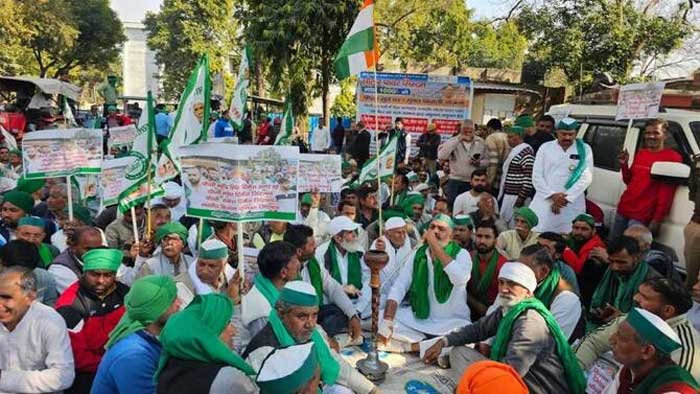
Thousands of farmers staged demonstrations across India on Thursday, from Punjab to Tamil Nadu, voicing opposition to a long-anticipated trade agreement with the United States that protesters fear could harm domestic agriculture.
The rallies, held despite Washington softening its language on the deal earlier this week, highlight the delicate balancing act facing Prime Minister Narendra Modi. The government is seeking relief from steep US tariffs while attempting to safeguard India’s rural economy and preserve certain trade ties with Russia.
In Punjab, one of India’s key agricultural states, large crowds of farmers — joined by industrial and rural workers — raised slogans against both Modi and US President Donald Trump. Protesters also expressed broader grievances over rural policies, including employment schemes and proposed legislation related to seeds and electricity.
“This is a betrayal of the country,” said Raminder Singh of the Samyukt Kisan Morcha (SKM), one of the groups organizing the protests. He accused the government of yielding to US pressure, warning that increased American imports could undermine Indian farmers. “We do not support this open-ended trade deal with the US,” he said.
Government Seeks to Calm Concerns
The government has attempted to ease anxieties around the negotiations. Commerce Minister Piyush Goyal has repeatedly stated that sensitive agricultural sectors such as dairy and poultry are excluded from the talks. He has also stressed that India will not permit concessions on genetically modified (GM) crops, a politically sensitive issue.
While India has not formally banned GM crops, regulatory and legal barriers have largely prevented their widespread adoption, with cotton being a notable exception.
However, analysts note that some concessions could still expose parts of India’s vast agricultural sector — valued at roughly $580 billion — to greater foreign competition. These include permitting imports of DDGS (distillers dried grains), an ethanol byproduct widely used in animal feed in the US and often derived from GM corn. Reduced duties on soybean oil are also expected to enhance the competitiveness of American supplies.
Opposition Voices Grow
Protest leaders argue that such measures could weaken domestic producers.
“This government is trying to sell the sovereignty of our country by cutting deals,” said Ramesh Parashat of the All India United Trade Union Centre. “They want to open the agriculture sector to corporates.”
Demonstrations were not limited to traditional farming regions. Protests were reported across northern India as well as in southern states including Tamil Nadu and Kerala. In New Delhi, hundreds gathered at Jantar Mantar, a prominent protest site near Parliament, waving flags and banners while raising concerns about agricultural policies and recent labor reforms.
“This free trade agreement is about a rich country catching a weaker one and signing a bilateral deal,” said Hannan Mullah, a senior SKM leader. “This deal is suicidal and will destroy Indian produce.”
Uncertainty Over Deal Details
The protests follow US President Donald Trump’s announcement earlier this month of a surprise breakthrough after a conversation with Modi. Trump indicated that Washington would reduce tariffs in exchange for increased Indian purchases of US goods and curbs on Russian oil imports.
While the development was seen as easing months of trade tensions, New Delhi has disclosed few specifics, contributing to uncertainty.
A revised White House fact sheet this week removed references to pulses — a staple in Indian diets — and softened language regarding India’s purchasing commitments, further fueling speculation about the agreement’s scope.
Comments are closed.