
EU and Gulf States Forge Stronger Alliance on Gaza Ceasefire, Two-State Solution at UN Conference

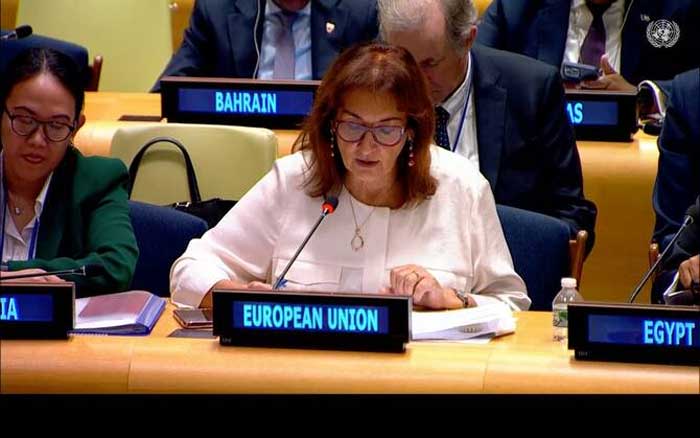
The European Union and Gulf nations—led by Saudi Arabia—are showing growing unity in calls for an immediate ceasefire between Israel and Hamas, urgent humanitarian relief, and a renewed political process for Gaza and the West Bank, according to EU Commissioner for the Mediterranean Dubravka Šuica.
Speaking to Arab News on the sidelines of a high-level international conference at the United Nations in New York, Šuica emphasized a shared EU-Gulf commitment to “peace, security and prosperity” as the foundation for deeper cooperation on the Israeli-Palestinian conflict.
The two-day summit, formally titled the High-Level International Conference for the Peaceful Settlement of the Question of Palestine and the Implementation of the Two-State Solution, is co-chaired by Saudi Arabia and France and seen as a pivotal moment in efforts to revive peace talks and chart a postwar future for Gaza.
“This is a historic moment,” said Šuica. “We are mature enough—and seeing what is happening on the ground, this conference might be the trigger to say: enough is enough.”
Šuica voiced full backing for the Saudi-led Arab Peace Initiative and stressed the alignment between the EU and Gulf states on the urgent need for both a ceasefire and a credible political path forward. “We are aligned on that. We would like to follow, we would like to engage,” she said.
EU Shifts from Payer to Player
While the EU’s foreign policy leadership rests with High Representative Kaja Kallas, Šuica said her focus is on the economic and developmental track—especially postwar reconstruction in Gaza. She confirmed that the EU will launch a donors’ platform this fall to coordinate international aid and support institutional development in Palestinian territories.
The EU has committed €1.9 billion (approx. $2.2 billion) to Palestinian reforms through 2027, with €150 million already disbursed. It is also funding the UN Relief and Works Agency (UNRWA), which remains the sole provider of essential services like healthcare and education in Gaza.
“We don’t want to be only a payer—we want to be a player,” Šuica said, adding that the EU aims to empower the Palestinian Authority to ultimately take over service delivery and governance responsibilities.
Complex Relations with Israel
Despite criticism of Israeli actions in Gaza and the West Bank, Šuica underscored the importance of maintaining diplomatic channels with Israel. She acknowledged that Israel had “breached Article Two” of its Association Agreement with the EU, but noted the lack of consensus among member states for a suspension.
“If we block everything, who is our interlocutor?” she asked, while also highlighting growing public and media pressure within the EU that could influence future policy.
Šuica condemned Israel’s delay in implementing humanitarian agreements and criticized the withholding of Palestinian tax revenues, now stretching into a third month. She also denounced the spike in settler violence in the West Bank, calling it “unacceptable” and a direct threat to any peace framework.
“We’ve had one or two rounds of sanctions [on violent settlers], but for more we need unanimity—and that’s always a problem within the EU,” she added.
Looking Ahead: Recognition and Regional Peace Efforts
Šuica hinted that September’s UN General Assembly could bring key announcements, including additional countries moving to formally recognize the State of Palestine—following France’s lead. This momentum is part of a broader “Peace Day Effort” spearheaded by the EU, Arab League, Saudi Arabia, Jordan, and Egypt. The initiative seeks to establish a long-term support mechanism, combining economic aid, political backing, and regional security coordination to sustain any future peace deal.
“This is not just about Gaza,” Šuica concluded. “This is about the future architecture of peace and security in the entire region. The Gulf countries are critical partners in this effort. We are aligned, and we are determined.”
With the humanitarian crisis in Gaza deepening and tensions escalating across the West Bank, the EU-Gulf coalition may represent the most serious, unified international push for a two-state solution in over a decade. The clock now ticks toward September’s UN summit, where diplomacy will be tested against the urgency of facts on the ground.
Comments are closed.