
Engine Failure, Stall or Late Runway View? Three Theories Behind Ajit Pawar Plane Crash

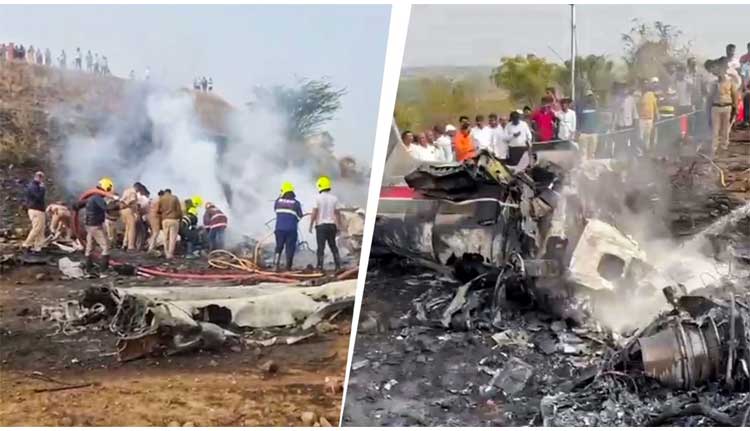
Investigators are probing the cause of the fatal plane crash near Baramati on Wednesday that killed Maharashtra Deputy Chief Minister Ajit Pawar and four others. The black box of the Learjet 45 business jet has been recovered, and a three-member team from the Aircraft Accident Investigation Bureau (AAIB) is leading the inquiry.
Attention has now focused on newly surfaced CCTV footage showing the aircraft’s final moments. The video appears to show the jet’s left wing dropping suddenly just before impact, with the aircraft banking sharply midair before crashing.
Experts say the footage points to three possible causes: an aerodynamic stall, an engine failure, or a steep turn made too close to the ground. However, they stress that only a detailed investigation can determine the exact cause.
Possible Aerodynamic Stall
An aerodynamic stall occurs when an aircraft’s speed or angle of attack prevents its wings from generating sufficient lift, causing a sudden loss of altitude. In an asymmetric stall, one wing loses lift before the other, leading to a rapid roll.
The Learjet 45 has tail-mounted engines, similar to other business jets that have been involved in fatal asymmetric stall accidents. The US National Transportation Safety Board has linked several crashes since 2014 to pilots exceeding the critical angle of attack during approach manoeuvres, including incidents involving a Phenom 100, Learjet 35A and Challenger 605.
Investigators will examine whether the pilots became too slow while visually aligning with the runway. The aircraft had reportedly attempted one landing and executed a go-around before the fatal second approach.
CS Randhawa, president of the Federation of Indian Pilots, said the footage suggests a stall. “Due to low speed, it appears the aircraft crossed the critical angle of attack, increasing drag and reducing lift. This likely caused a wingtip stall,” he said, adding that the flight data and cockpit voice recorders would provide crucial evidence.
Possible Engine Failure
A second theory is engine failure. According to the US Federal Aviation Administration, loss of power in one engine can cause yaw and roll due to uneven thrust and lift.
However, experts consider this less likely because no distress call was made between landing clearance and the crash. They said flight data would clarify whether engine problems occurred.
Mark D Martin of Martin Consulting said the Learjet 45 is not designed to perform well at very low speeds. “When one engine fails, power from the other can pull the aircraft to one side,” he said.
Late Runway Visual Contact
A third theory relates to limited navigation facilities at Baramati airport, which relies largely on visual approaches.
Aviation safety expert Amit Singh said pilots must have the runway clearly in sight during such approaches. “Sun glare and poor visibility may have affected alignment, and the crew may have realised too late that they were off course,” he said.
Another pilot, speaking anonymously, suggested the crash may have resulted from a late attempt to correct alignment using a steep bank angle.
Ongoing Investigation
Authorities emphasised that conclusions will only be drawn after analysing flight data, cockpit recordings and technical evidence. The AAIB investigation is expected to determine whether pilot error, mechanical failure, environmental factors or a combination of issues caused the tragedy.
Comments are closed.