
Endless Rains to El Niño: How Climate Change Has Disrupted the Seasons

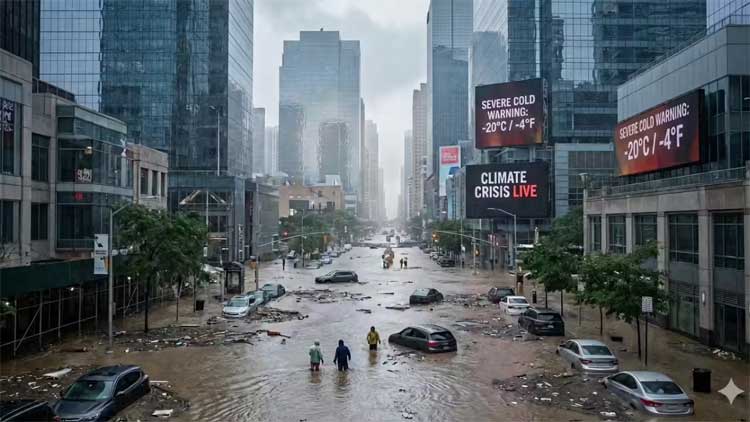
“It’s beginning to look a lot like Christmas…”—except this year, it didn’t.
Christmas in Delhi recorded an average temperature of 14°C, unusually warm for late December. Days later, a sharp cold wave swept across north India, delivering the coldest New Year’s Eve in five years. As 2026 began, dense fog, plummeting temperatures, and toxic air blanketed Delhi and large parts of the region.
These abrupt swings are no longer rare. They are symptoms of a deeper shift—one that scientists say is quietly dismantling the seasonal rhythm humanity has relied on for centuries.
For generations, life has been guided by predictable transitions: winter’s chill, spring’s renewal, summer’s heat, and autumn’s retreat. Farmers planned crops, festivals followed rainfall cycles, and ecosystems evolved in sync with these changes. Today, that certainty is fading. Meteorologists increasingly remark that “February feels like April,” and what once felt stable now feels strangely unfamiliar.
What are seasons — and why do they matter?
Seasonality refers to the regular, repeating changes in weather and environmental conditions that occur every year—summer heat, winter cold, monsoon rains, or dry spells. These changes are defined not just by temperature or rainfall, but by how reliably they repeat over time.
Explaining their importance, Jawaharlal Nehru University (JNU) geography professor Dr Milap Punia describes seasons as “nature’s timetable.”
“In the natural world, plants and animals depend on seasonal cues to decide when to flower, migrate, reproduce, or rest,” he explains. “Birds time the raising of chicks to coincide with insect abundance, while ecosystems rely on seasonal variation to allow different species to thrive at different times.”
Seasonal patterns also influence disease spread, as temperature and rainfall affect mosquito populations, immunity, and human behaviour.
For humans, seasons provide predictability—especially in agriculture. “Farmers rely on timely rainfall and temperature patterns to sow and harvest crops,” Dr Punia says. “When seasons become erratic, food security, public health, and livelihoods are put at risk.”
In simpler terms, he adds, seasonality functions like a traffic signal system. “When it works, everything moves smoothly. When it fails or changes without warning, confusion spreads across both nature and society.”
The disappearing seasons: What’s changing?
The familiar four-part structure of the year is slowly dissolving. Winters are growing shorter and milder, summers are arriving earlier and in sudden bursts, and rainfall patterns have become increasingly erratic. Extreme events—heatwaves, floods, landslides—are no longer exceptions but recurring headlines.
“This is not poetic exaggeration,” experts warn. “It is lived reality.”
Traditional seasons are shrinking, shifting, or vanishing altogether. In many parts of India, the long-standing “seasonal clock” that communities depended on for generations is breaking down.
Dr Punia points to Kashmir as a striking example. The springtime rainy season known as sonth, which once bridged winter and spring, has largely disappeared. It has been replaced by extended dry spells following earlier-than-usual snowmelt—disrupting agriculture and water availability.
The Indian summer monsoon, too, is changing shape. Rainfall has shifted westward, with western India experiencing heavier downpours, while the Indo-Gangetic Plain and parts of northeast India—historically reliable farming regions—are seeing increasing dryness.
This reorganisation is closely linked to warming in the Indian Ocean, which diverts moisture-laden winds toward the Arabian Sea and away from traditional agricultural belts.
Nature’s warning signs
Biological signals reveal the same confusion. Farmers report that natural indicators—such as insect emergence—no longer align with planting and harvesting cycles. In Himalayan regions, fruits like raspberries are ripening up to two months earlier than they did a few decades ago.
“These changes match global scientific projections,” Dr Punia notes. “By the end of the century, summers could stretch close to six months, while winters may shrink dramatically.”
For India, where culture, food security, festivals, and livelihoods are deeply intertwined with seasonal rhythms, this transformation goes far beyond weather.
“The fading of traditional seasons is not just a climatic shift,” he says. “It is a serious social, ecological, and economic challenge—one that demands urgent attention.”
As dense fog blankets New Year mornings and winters arrive late—or leave too soon—the question grows harder to ignore: if the seasons are changing beyond recognition, are we prepared for what comes next?
Comments are closed.