
Eight Killed as B-52 Bomber Crashes During Test Flight at California Air Force Base

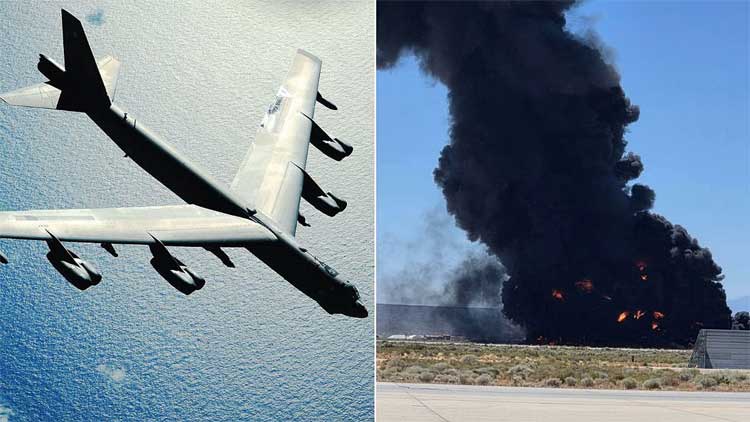
A B-52 Stratofortress bomber crashed and burst into flames shortly after takeoff from Edwards Air Force Base in California’s Mojave Desert on Monday, killing all eight people on board, US military officials said.
The aircraft went down at about 11:20 a.m. during what officials described as a routine test mission. Dramatic aerial footage showed the bomber reduced to wreckage, with thick black smoke rising from a scorched area near the runway as emergency crews responded to the scene.
Those aboard included both military personnel and government contractors. After reviewing crash footage, officials concluded there were no survivors.
“We lost eight great Americans,” Col. James Hayes, deputy commander of the 412th Test Wing, said at a press briefing, adding that authorities were notifying the victims’ families.
The cause of the crash remains under investigation, a process that could take up to six months. Hayes said the aircraft was supporting the Air Force’s radar modernization program at the time of the accident.
The Boeing B-52 Stratofortress, which entered service in 1955, remains a cornerstone of the US strategic bomber fleet. Designed to carry both conventional and nuclear weapons, the aircraft has been deployed in conflicts ranging from Vietnam to recent operations in the Middle East.
Edwards Air Force Base has been central to testing a modern Active Electronically Scanned Array (AESA) radar system intended to replace the bomber’s aging radar technology. Boeing delivered a modified B-52 equipped with the new system to Edwards in 2025 for an extensive testing campaign scheduled through 2026. Officials have not confirmed whether Monday’s crash involved that aircraft.
Located about 100 miles north of Los Angeles, Edwards is the Air Force’s premier flight-test center and home to the 412th Test Wing, which oversees developmental testing of aircraft, weapons systems, software and advanced technologies.
Aviation safety experts cautioned against drawing conclusions before investigators examine the wreckage, but the aircraft’s rapid descent after takeoff may offer clues.
Jeff Guzzetti, a former crash investigator for both the Federal Aviation Administration and the National Transportation Safety Board, said the limited altitude and distance achieved before impact suggest a possible flight-control problem.
“It was definitely a controllability issue,” Guzzetti said, noting that potential causes could include a flight-control malfunction, an engine failure, maintenance-related errors or a problem with equipment being tested.
He added that flight-testing operations inherently carry greater risks than routine military missions because experimental systems can introduce unforeseen challenges despite extensive safety measures and specially trained crews.
The crash temporarily shut down airfield operations at Edwards, with incoming aircraft diverted elsewhere while emergency teams battled the fire. Access restrictions remained in place for much of the day as investigators began examining one of the deadliest Air Force test-flight accidents in recent years.
Comments are closed.