
Doomsday Clock Moves Closer to Midnight Amid Nuclear, Climate and AI Risks

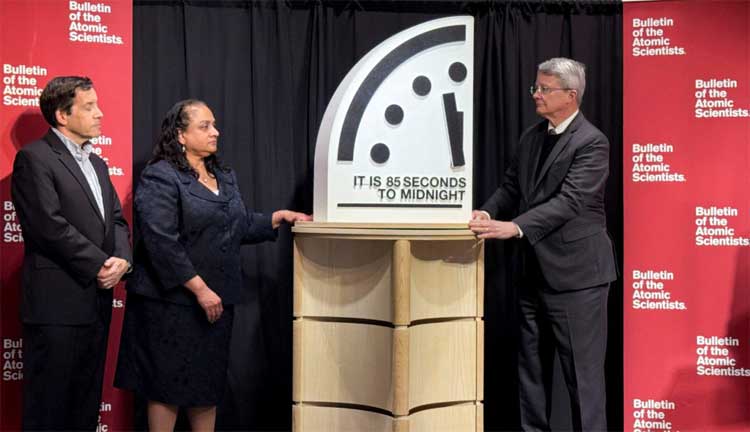
Earth is closer than ever to catastrophe as major powers including Russia, China and the United States grow more aggressive, adversarial and nationalistic, the Bulletin of the Atomic Scientists said Tuesday, moving its Doomsday Clock to 85 seconds before midnight.
The announcement followed an initial demonstration last week, with the final update released on Tuesday. The clock symbolically measures how close humanity is to self-destruction.
Scientists cited rising risks from nuclear conflict, climate change, the misuse of biotechnology, and the rapid spread of artificial intelligence without adequate safeguards.
Last year, the clock stood at 89 seconds to midnight. Since then, the group said, fragile international agreements have weakened, fueling great-power rivalry and undermining cooperation needed to reduce global threats.
The Bulletin warned of escalating tensions involving nuclear-armed nations, pointing to the Russia-Ukraine war, recent clashes between India and Pakistan, and concerns over Iran’s nuclear capabilities following last summer’s US and Israeli strikes.
Daniel Holz, chair of the group’s science and security board, stressed the importance of global cooperation.
“If the world splinters into an us-versus-them, zero-sum approach, it increases the likelihood that we all lose,” he said.
The group also highlighted worsening climate impacts, including droughts, heat waves and floods, and criticized the lack of strong international action on climate change. It specifically pointed to President Donald Trump’s push to expand fossil fuel production and weaken renewable energy efforts.
Founded in 1947, the Bulletin created the Doomsday Clock to represent the risk of human-made catastrophe. At the end of the Cold War, it was set at 17 minutes to midnight. In recent years, amid rapid global change, the clock has been measured in seconds rather than minutes.
The group said the clock could still be turned back if world leaders work together to confront existential threats.
Comments are closed.