
Donald Trump vows to ‘take’ Cuba as island reels under Washington’s oil embargo

Authorities in Cuba reported a nationwide blackout on Monday affecting the island’s roughly 11 million residents, as the country’s deepening energy and economic crises continue to strain its crumbling power grid.
The Cuba Ministry of Energy and Mines said on X that the country’s electrical system had suffered a “complete disconnection.” Officials added that an investigation was underway and noted that none of the generating units operating at the time had reported failures when the grid collapsed.
It was the third major blackout to hit Cuba in the past four months.
Tomás David Velázquez Felipe, a 61-year-old resident of Havana, said the relentless outages have left many Cubans wondering if they should leave the island. “What little we have to eat spoils,” he said. “Our people are too old to keep suffering.”
Cuba’s aging electricity network has deteriorated sharply in recent years, leading to frequent daily outages and repeated nationwide blackouts. The government has partly blamed the crisis on US sanctions, saying an energy blockade has worsened shortages after Donald Trump in January warned of tariffs on countries that sell or supply oil to Cuba.
The Trump administration has demanded that Havana release political prisoners and move toward political and economic liberalisation in exchange for easing sanctions. Trump has also floated the idea of a “friendly takeover” of the island.
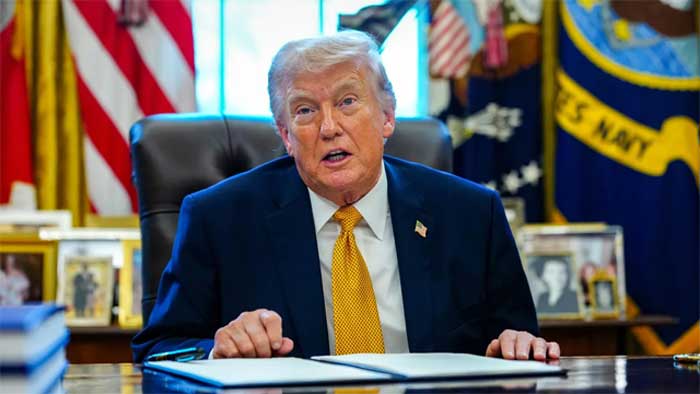
On Monday, he said he believed he would have the “honor of taking Cuba.” “Whether I free it or take it, I think I could do anything I want with it,” he said, describing Cuba as a “very weakened nation.”
The U.S. Embassy in Cuba said on X that there was no indication when electricity might be restored. It warned that Cuba’s national grid is increasingly unstable and that prolonged scheduled and unscheduled outages are now a daily occurrence, urging residents to conserve fuel, water, food and phone battery power.
Grinding blackouts
William LeoGrande, a professor at American University who has long studied Cuba, said the island’s grid has not been properly maintained and much of its infrastructure is well past its useful life.
“The technicians working on the grid are magicians to keep it running at all given the shape that it’s in,” LeoGrande said.
He warned that even if Cuba sharply reduces electricity consumption and expands renewable energy, the country would still face prolonged hardship without steady oil supplies. “It would be constant misery for the general population, and eventually the economy could collapse completely, leading to social chaos and probably mass migration,” he said.
To accelerate solar power expansion beyond last year’s pace, LeoGrande said other countries — particularly China — would likely need to significantly increase their supply of equipment.
President Miguel Díaz-Canel said last week that the island had not received oil shipments for three months and was relying on solar energy, natural gas and thermoelectric plants. The shortages have been so severe that the government has postponed tens of thousands of surgeries.
Yaimizel Sánchez Peña, 48, said food she buys with money sent by her son in the United States keeps spoiling during the outages. The situation has also been hard on her 72-year-old mother. “Every day, she suffers,” she said.
Another resident, 71-year-old Mercedes Velázquez, said the repeated blackouts have become unbearable. “We’re here waiting to see what happens,” she said, explaining that she recently gave away part of a freshly made soup so it would not spoil. “Everything goes bad.”
‘A perfect storm of collapse’
A major power outage just over a week ago left millions in western Cuba without electricity, while another widespread blackout struck the region in early December.
Oil shipments from Venezuela — a key supplier — were halted after the United States moved against the South American country in early January and detained its then-president, Nicolás Maduro.
Although Cuba produces about 40% of its own petroleum and generates some of its own electricity, it has not been enough to meet demand as the power grid continues to deteriorate.
LeoGrande said the government also lacks the hard currency needed to import spare parts or modernise power plants and transmission networks. “It’s just a perfect storm of collapse,” he said, adding that thermoelectric plants burning heavy oil are also suffering corrosion because of the fuel’s high sulphur content.
Amid the worsening crisis, Díaz-Canel confirmed on Friday that Cuba was in talks with the United States as it seeks ways to address the country’s mounting energy problems.
Comments are closed, but trackbacks and pingbacks are open.