
‘Different Footing’: Supreme Court Denies Bail to Umar Khalid, Sharjeel Imam

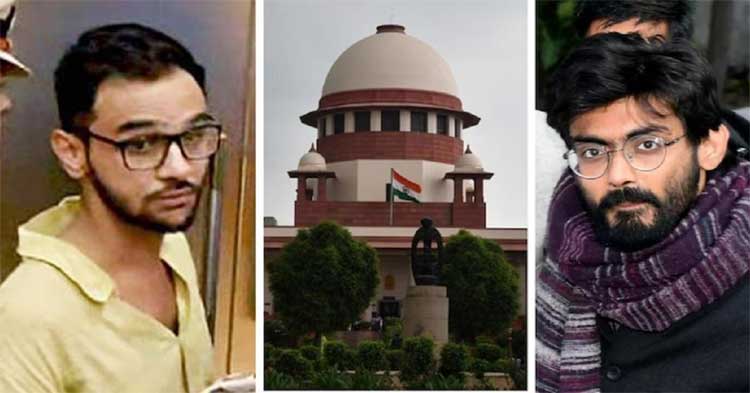
The Supreme Court on Tuesday refused to grant bail to student activists Umar Khalid and Sharjeel Imam in the 2020 Delhi riots conspiracy case, citing their alleged “central” and “strategic” roles in the purported conspiracy, which set them apart from other accused, who were largely local-level participants.
In a detailed 142-page judgment, Justices Aravind Kumar and NV Anjaria distinguished between planning and execution under the Unlawful Activities (Prevention) Act (UAPA), noting that bail must consider the hierarchy and nature of participation, not merely parity with other accused or length of incarceration.
Central vs. subsidiary roles
The court observed that prosecution material consistently portrays Khalid and Imam as ideological drivers and coordinators of the alleged plot, involved in planning, mobilisation, and strategy from December 2019 after the passage of the Citizenship Amendment Act (CAA). In contrast, other accused were described as local facilitators, handling logistics, crowd mobilisation, and executing directions at protest sites such as Seelampur, Jafrabad, Chand Bagh, Jamia, and Shaheen Bagh.
Khalid was credited with supplying the “method,” “timing,” and “linkage” between sites, while Imam allegedly coordinated mobilisation platforms, meetings, speeches, and WhatsApp groups. The court said these roles indicate planning rather than mere presence at riot sites, emphasizing that physical absence from violence does not negate prima facie involvement in a conspiracy.
Planned strategy, not spontaneous protest
The bench highlighted prosecution claims that the agitation evolved into a sustained “chakka jam” strategy to block roads and disrupt civic life. It held that the chain of acts — planning, coordination, mobilisation, and public exhortation — could not be dismissed as mere protest. Speeches by both accused were considered part of a larger orchestrated strategy rather than isolated incidents of expression.
Why parity and delay did not help
The court rejected arguments based on parity with co-accused who were granted bail and concerns about prolonged incarceration. Under Section 43(D)(5) of UAPA, once the prosecution case is prima facie credible, bail is legally impermissible. Delay alone cannot override this statutory bar, and the court noted that remedy lies in speedy trial, not diluting UAPA provisions.
Bail may be reconsidered
While denying bail, the court allowed Khalid and Imam to renew their plea after examination of protected witnesses or one year, whichever is earlier. The judgment clarified that all observations are confined to the bail stage and will not influence the trial on merits.
In essence, the Supreme Court’s decision underscores that under UAPA, conceptual and strategic roles in an alleged conspiracy carry decisive weight at the bail stage, even without direct involvement in acts of violence.
Comments are closed.