
Dhankhar Defied Pressure Before Resignation Over Impeachment Notice Against Justice Varma

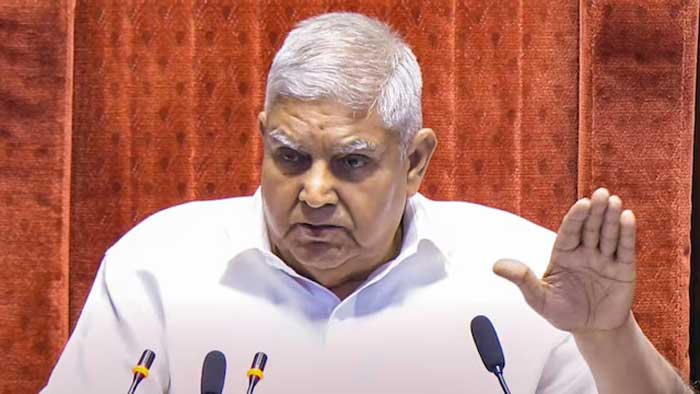
At least two senior ministers from the Union government reached out to Vice President Jagdeep Dhankhar after learning he had acknowledged an Opposition-backed impeachment notice against Justice Yashwant Varma in the Rajya Sabha — a move that stunned the Centre and disrupted its own carefully laid plans.
Union Health Minister and Rajya Sabha Leader JP Nadda, along with Parliamentary Affairs Minister Kiren Rijiju, both reportedly contacted Dhankhar on Monday. Rijiju hinted that Prime Minister Narendra Modi was displeased with the unexpected development and reminded Dhankhar that impeachment motions traditionally begin in the Lok Sabha, not the Upper House. He also pointed out that the Lok Sabha’s Leader of the Opposition, Rahul Gandhi, had signed the notice — an implicit signal of a potential political trap.
Dhankhar, however, insisted he was acting within the constitutional rules and procedures governing the Rajya Sabha. According to sources familiar with the matter, this exchange happened shortly after the first Business Advisory Committee (BAC) meeting that afternoon. Nadda and Rijiju subsequently skipped the second BAC meeting that Dhankhar was scheduled to lead — a conspicuous political snub. By Monday night, the 74-year-old vice president had resigned, citing health reasons.
His abrupt resignation — coming just hours after that BAC meeting — set off a chain of high-level political activity. Top ministers, including Home Minister Amit Shah, Nadda, and Rijiju, met Lok Sabha Speaker Om Birla and Rajya Sabha Deputy Chairman Harivansh to discuss the fallout. Sources said the government is now weighing whether to initiate the impeachment process via the Lok Sabha instead — in line with its original strategy.
Multiple officials confirmed that the resignation and the ensuing flurry of meetings were directly linked to Dhankhar’s decision to admit the Rajya Sabha notice signed by 63 Opposition MPs. The government, blindsided by the development, is now unlikely to act on that particular notice and prefers to route the process through a notice initiated in the Lok Sabha.
Separately, the Election Commission of India announced it had begun preparing for the upcoming vice-presidential election. The 782-member electoral college — made up of MPs from both houses — will vote on a new vice president within 30 days once the election schedule is formally announced. The ruling NDA holds a majority with 426 MPs, while the Opposition INDIA bloc has 312.
Meanwhile, Congress president Mallikarjun Kharge confirmed that the INDIA alliance will meet soon to decide on its nominee for the post.
Dhankhar’s resignation letter, submitted to President Droupadi Murmu, cited medical advice and invoked Article 67(a) of the Constitution to make his exit effective immediately. The Union Home Ministry issued a gazette notification formalizing the decision the same day. Prime Minister Modi’s response — a brief message posted more than 15 hours later — made no reference to the controversy.
The root of the political storm lies in the explosive impeachment motion targeting Justice Varma, who is under scrutiny after charred cash was found at his official residence. While the government had planned to handle the matter on its own terms, Dhankhar’s move — reportedly encouraged by some Opposition leaders last week — blindsided the administration.
A senior Congress MP, also a lawyer, is said to have quickly drafted the impeachment notice on Sunday. All 63 signatories were from the Opposition. Not a single NDA MP was aware that the motion was being prepared, let alone participated in it.
Dhankhar himself came to the Rajya Sabha after Monday’s first BAC meeting and announced on the floor:
“I need to inform you that I have received a notice of motion under Article 217(1)(B) read with Articles 218 and 124…to constitute a statutory committee for the removal of Justice Yashwant Varma. This has been received by me today. It is signed by more than 50 members of the Council of States.”
That announcement upended the government’s strategy, led to a visible rupture within the ruling establishment, and culminated in a resignation that has shaken Parliament’s monsoon session just as it began.
Comments are closed.